WatchIQ
Bulova
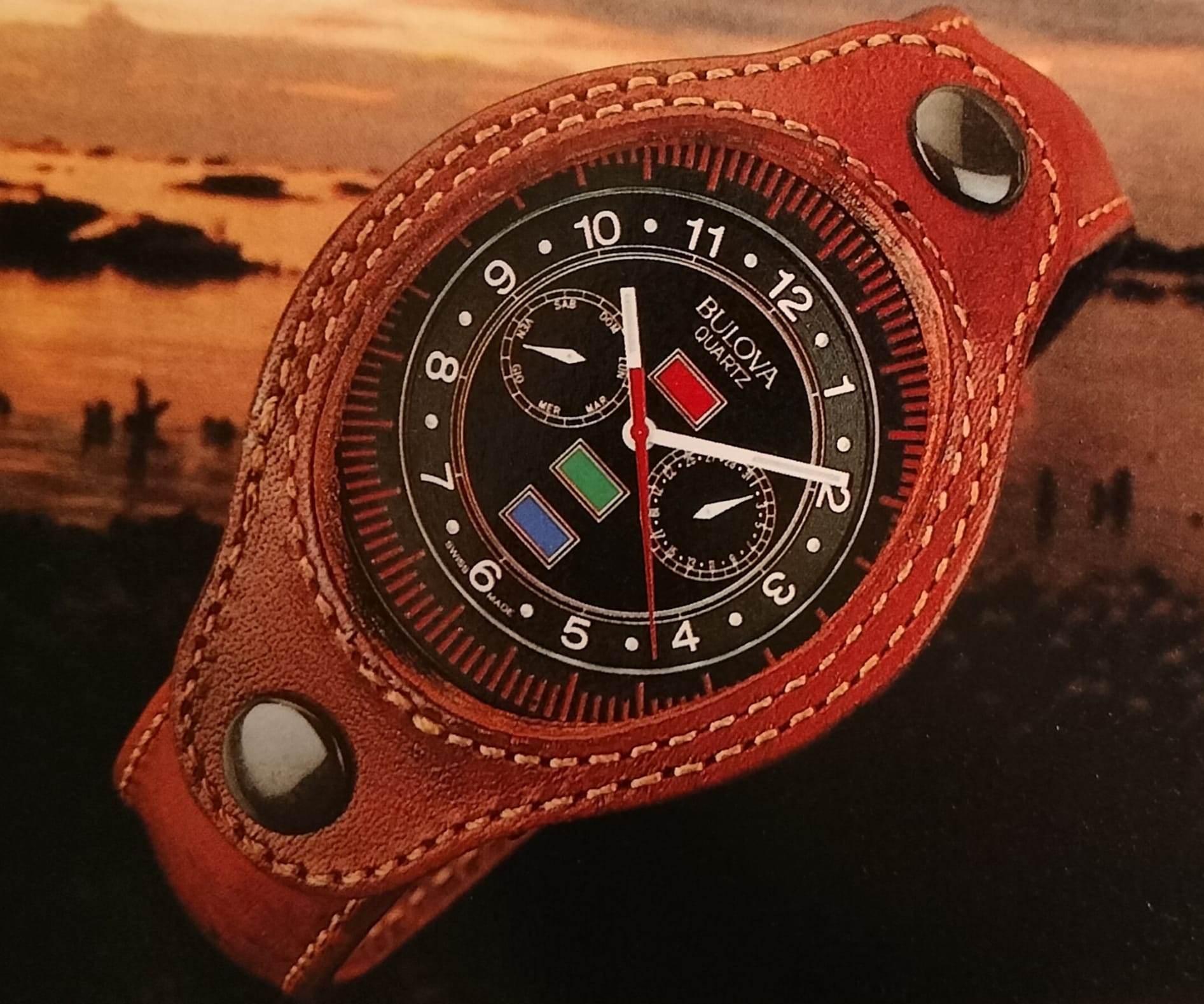
Bulova Benetton 'United Colors' World Time Day-Date
Market Estimate
~$450
Specifications
Market Range
Bulova
Bulova Benetton 'United Colors' World Time Day-Date
Market Estimate ~ $450
Market Range
Specifications
Executive Overview
The late 1980s Bulova Benetton 'United Colors' collaboration represents a fascinating intersection of high-fashion marketing and traditional Swiss-made horology. During an era where Benetton was dominating the global cultural zeitgeist with its provocative advertising and vibrant color palettes, Bulova was commissioned to produce a series of timepieces that captured this energy while maintaining professional manufacturing standards. This specific model is a standout within the collection, featuring a sophisticated day-date complication and a distinctive 'World Time' aesthetic. Unlike the more common plastic 'pop' watches of the era, this Bulova-engineered piece utilized a Swiss quartz movement and a more substantial case construction. It exists as a time capsule of 1980s postmodern design, characterized by the use of primary color blocks—red, green, and blue—set against a stark black dial. For collectors, this watch is prized not just for its brand name, but as a definitive artifact of 1980s design language. It appeals to those who value the 'neo-vintage' movement and the unique history of cross-industry collaborations that defined the pre-luxury-conglomerate era of the watch industry.
Technical Architecture
At its core, this timepiece is powered by a high-grade Swiss quartz movement, ensuring the reliability and precision required for a multi-function calendar watch. The dial architecture is complex for its genre, featuring two sub-dials: one at the 10 o'clock position indicating the day of the week (notably in Italian, reflecting the brand's heritage) and another at the 4 o'clock position for the date. The center of the dial is dominated by the iconic Benetton 'United Colors' rectangles, providing a sharp geometric contrast to the circular sub-dials. The case is constructed from stainless steel, typically finished in a matte black PVD or chrome plating to enhance the 'sport-fashion' aesthetic. The crystal is a hardened mineral glass, sitting flush with a fixed bezel that features a detailed minute track. One of the most defining technical features of this specific reference is the integrated 'Bund' style leather strap. This wide, cuff-like leather base was originally designed for pilots to prevent the watch case from touching the skin in extreme temperatures, but here it serves a purely stylistic purpose, giving the watch a significant wrist presence and a rugged, adventurous character that was highly fashionable in the late 80s.
Historical Context
The late 1980s was a period of transition for Bulova as they navigated the post-Quartz Crisis landscape by leaning into lifestyle and fashion partnerships. The collaboration with Benetton, an Italian global fashion brand, was a masterstroke of market positioning. Benetton was at its peak of influence, known for its 'United Colors' campaign which championed diversity and globalism—themes reflected in the multi-language day wheels and the 'Swiss Made' designation on the dial. This model was part of a broader collection that included simpler three-handers and more colorful plastic variants, but the metal-cased day-date versions were positioned as the premium tier of the lineup. It represents the era's move toward 'watch-as-accessory,' yet because it was manufactured by Bulova in Switzerland, it avoided the 'disposable' stigma of many fashion watches. Historically, it sits alongside other famous 80s collaborations like the early TAG Heuer Formula 1 or the first Seiko Giugiaro designs, where functional tool-watch aesthetics were reinterpreted through a lens of high-contrast, graphic pop art.
Market Intelligence
From an investment and market perspective, the Bulova Benetton collection is currently experiencing a resurgence in interest driven by the 'Gen X' and 'Millennial' nostalgia cycles. While it does not command the five-figure prices of mechanical blue-chip references, it occupies a high-growth niche in the 'affordable vintage' market. Supply is relatively constrained because many of these watches were worn heavily as daily fashion items and subsequently lost or discarded; finding an example in mint condition with the original Bund strap is increasingly difficult. The secondary market behavior shows high liquidity among design-focused collectors who prioritize aesthetic uniqueness over mechanical complexity. Brand strength is twofold: Bulova provides the horological credibility, while the Benetton branding provides the cultural 'cool factor.' Long-term value retention is expected to be stable with moderate appreciation, particularly for the more complicated day-date models which are seen as the 'complications' of the fashion watch world. As the market continues to move away from oversized modern watches toward smaller, more expressive vintage pieces, this 35-38mm range timepiece is perfectly positioned for contemporary tastes.