WatchIQ
Bulova
Bulova Lunar Pilot Chronograph (96B251)
Market Estimate
~$450
Specifications
Market Range
Bulova
Bulova Lunar Pilot Chronograph (96B251)
Market Estimate ~ $450
Market Range
Specifications
Executive Overview
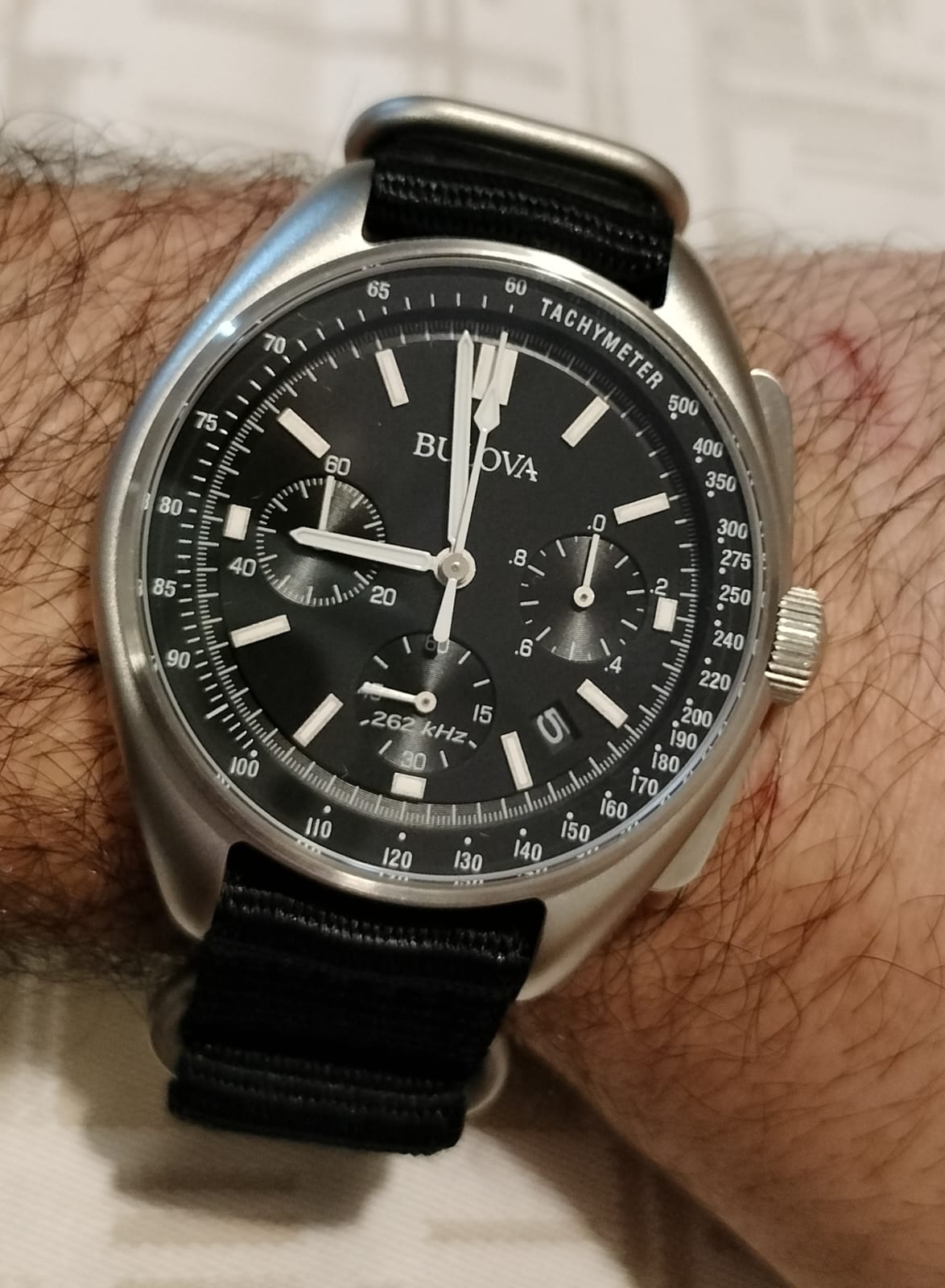
The Bulova Lunar Pilot Chronograph is a modern horological tribute to one of the most significant moments in space exploration history. While the Omega Speedmaster is famously the 'Moonwatch,' Bulova holds the distinction of being the only other brand to have a privately owned timepiece worn on the lunar surface. During the Apollo 15 mission in 1971, Mission Commander David Scott utilized his personal Bulova chronograph after the crystal on his standard-issue Omega popped off. This modern reissue captures the utilitarian soul of that historic piece, updated with Bulova’s proprietary high-frequency technology. It exists as a compelling alternative for collectors who value genuine space heritage combined with extreme precision. The watch is defined by its unique elongated chronograph pushers and a sandblasted finish that emphasizes its tool-watch DNA. It appeals to enthusiasts who find the classic Speedmaster aesthetically pleasing but desire a more accessible price point and the 'set-it-and-forget-it' reliability of a high-end quartz movement. Its presence on the wrist is substantial, reflecting the oversized dimensions required for legibility during extravehicular activities on the Moon.
Technical Architecture
At the heart of the Lunar Pilot is Bulova's proprietary 262 kHz High-Performance Quartz movement. This three-prong crystal oscillator vibrates at a frequency eight times greater than a standard quartz movement, resulting in a continuous-sweep seconds hand for the chronograph and an accuracy rating of within seconds per year. The case is constructed from surgical-grade 316L stainless steel with a matte, sandblasted finish to reduce glare. Measuring 45mm in diameter, the case features a unique ergonomic silhouette with ultra-slim, elongated chronograph paddles that are easier to operate with gloves—a direct nod to its lunar origins. The dial is a deep velvet black with multi-level sub-dials, providing excellent depth and legibility. It utilizes a flat sapphire crystal with anti-reflective coating, ensuring durability and clarity in harsh lighting conditions. This specific variant is presented on a high-durability black NATO-style nylon strap with leather accents, mirroring the Velcro straps used by astronauts. The watch is water-resistant to 50 meters, sufficient for daily wear though it remains fundamentally a terrestrial and atmospheric instrument rather than a diver.
Historical Context
The history of the Bulova Lunar Pilot is rooted in the fierce competition of the 1960s space race. While NASA officially certified the Omega Speedmaster for all manned space missions, Bulova—an American-founded company—lobbied heavily for the inclusion of domestic technology. On August 2, 1971, during the Apollo 15 mission, Dave Scott’s issued Omega failed. He turned to his backup Bulova, which performed flawlessly during the lunar EVA. For decades, this story remained a niche fact among horological historians until the original prototype surfaced at auction in 2015, selling for a staggering $1.62 million. Recognizing the latent demand for this piece of history, Bulova released the Lunar Pilot in 2016. It replaced the original's mechanical movement with the brand's signature high-frequency quartz, merging 1970s aesthetics with 21st-century precision. It stands as a pillar of Bulova's 'Archive Series,' a collection dedicated to reviving the brand's most culturally and technologically significant designs from the mid-century era.
Market Intelligence
From an investment and market perspective, the Bulova Lunar Pilot is categorized as a high-value 'entry-level enthusiast' asset. It possesses a remarkably high demand-to-price ratio, driven largely by its unassailable historical pedigree. While it is a mass-produced model, it enjoys strong secondary market liquidity because it is widely regarded as a 'must-have' in any well-rounded collection. Value retention is stable; unlike many fashion-oriented quartz watches, the Lunar Pilot maintains a significant portion of its MSRP due to the technical superiority of the 262 kHz movement. Supply is consistent, but limited edition variants or specific dial configurations (such as the 'no-date' version) occasionally command small premiums. The brand strength of Bulova, backed by the manufacturing prowess of the Citizen Group, ensures long-term serviceability and parts availability. For a collector, the Lunar Pilot represents an 'intellectual' purchase—it is a watch that commands respect in enthusiast circles regardless of its price point, making it a low-risk addition to a portfolio that prioritizes historical narrative and functional reliability over raw capital appreciation.