WatchIQ
Cartier
Cartier Tank à Guichets Collection Privée Cartier Paris (CPCP)
Market Estimate
~$65,000
Specifications
Market Range
Cartier
Cartier Tank à Guichets Collection Privée Cartier Paris (CPCP)
Market Estimate ~ $65,000
Market Range
Specifications
Executive Overview
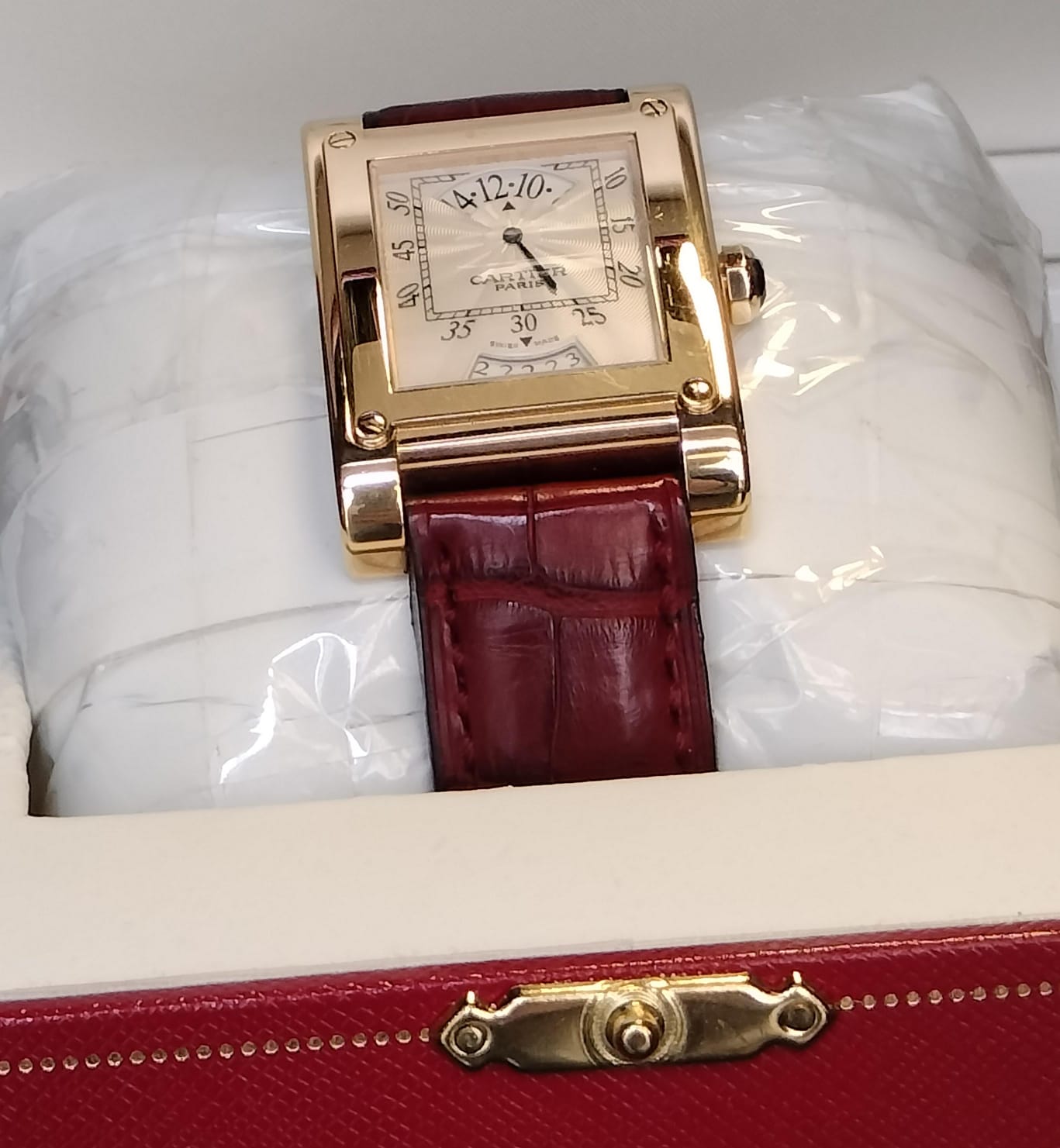
The Cartier Tank à Guichets represents one of the most intellectually stimulating and aesthetically daring chapters in the history of the Maison. Originally conceived in 1928 during the height of the Art Deco movement, this specific iteration belongs to the esteemed Collection Privée Cartier Paris (CPCP), a series produced between 1998 and 2008 that revived Cartier's most iconic historical designs with high-end mechanical movements. Unlike the traditional Tank which displays time via hands on an open dial, the à Guichets (meaning 'with apertures') utilizes a jumping hour mechanism and a dragging minute disc. This creates a 'digital' mechanical display that is both minimalist and avant-garde. The watch is defined by its solid gold facade, punctuated only by two small windows, challenging the conventional perception of a timepiece by hiding the movement's complexity behind a mask of precious metal. For the serious collector, the CPCP Tank à Guichets is a 'grail' piece, representing the bridge between Cartier’s early 20th-century creative peak and its modern era of haute horlogerie. It is a statement of discretion; it does not shout its presence but demands close inspection from those who understand its historical significance and mechanical rarity.
Technical Architecture
The engineering of the Tank à Guichets is centered on the Calibre 9752 MC, a manual-winding movement that replaces traditional hands with rotating discs. The 'jumping hour' complication is particularly demanding, requiring a precise build-up of tension that releases instantaneously at the top of the hour to snap the hour disc to the next numeral. The case is meticulously crafted from 18k yellow gold, featuring a brushed finish on the front face to reduce glare and highlight the apertures, while the flanks and the integrated lugs are typically polished to provide a sophisticated contrast. The crown is uniquely positioned at the 3 o'clock mark, often set with a sapphire cabochon, which is a signature of the CPCP line. Unlike modern sapphire-heavy designs, the 'crystal' here is minimal, protecting only the small apertures for the hour and minutes. The case dimensions are classically proportioned, maintaining the slim profile necessary for a dress watch of this caliber. The construction is solid and weighty, reflective of the high-purity gold used, and the watch is typically paired with a premium alligator leather strap and a matching 18k gold deployant buckle, ensuring the ergonomics match the aesthetic prestige.
Historical Context
The Tank à Guichets was first introduced in 1928, a period when Cartier was experimenting heavily with geometric forms and alternative time-telling methods. It was a radical departure from the Tank Normale and Tank Cintrée, removing the dial entirely in favor of a protective metal plate. This design was famously favored by icons like Duke Ellington, cementing its status as a choice for the cultural elite. After decades of dormancy, Cartier revived the model in 1997 for the brand's 150th anniversary as a limited edition of 150 pieces, followed by its inclusion in the ultra-exclusive Collection Privée Cartier Paris (CPCP) starting in 1998. The CPCP was Cartier’s response to the 'Quartz Crisis' and the subsequent mechanical renaissance, aiming to remind the world that Cartier was a true 'manufacture' capable of high-grade watchmaking. By utilizing movements from specialized makers like Piaget and Jaeger-LeCoultre (and later in-house refinement), the CPCP line, and the à Guichets in particular, successfully repositioned Cartier at the pinnacle of the luxury watch market, transitioning from a jeweler who made watches to a master horologer.
Market Intelligence
From an investment perspective, the Cartier Tank à Guichets CPCP is currently experiencing a significant value inflection point. As the market for 'neo-vintage' Cartier continues to explode, the CPCP models have become the primary target for sophisticated investors. Supply is strictly limited, as these were produced in very small batches compared to the mass-market Tank Louis Cartier or Santos models. Historically, the secondary market for the à Guichets was stable, but the last five years have seen a dramatic rise in auction results, with prices frequently exceeding $60,000 for well-preserved examples with original box and papers. The demand is driven by a global shift toward smaller, more elegant dress watches and a renewed appreciation for the 'Paris' signed dials which signify the CPCP era. Liquidity is high among specialist dealers and auction houses, as there is always a standing waitlist for these pieces. Because of its unique jump-hour complication and the precious metal content, it retains value far better than contemporary steel models. Long-term appreciation prospects remain strong as Cartier continues to elevate its brand positioning toward the ultra-high-end segment.