WatchIQ
Cartier
Must de Cartier 21
Market Estimate
~$1,250
Specifications
Market Range
Cartier
Must de Cartier 21
Market Estimate ~ $1,250
Market Range
Specifications
Executive Overview
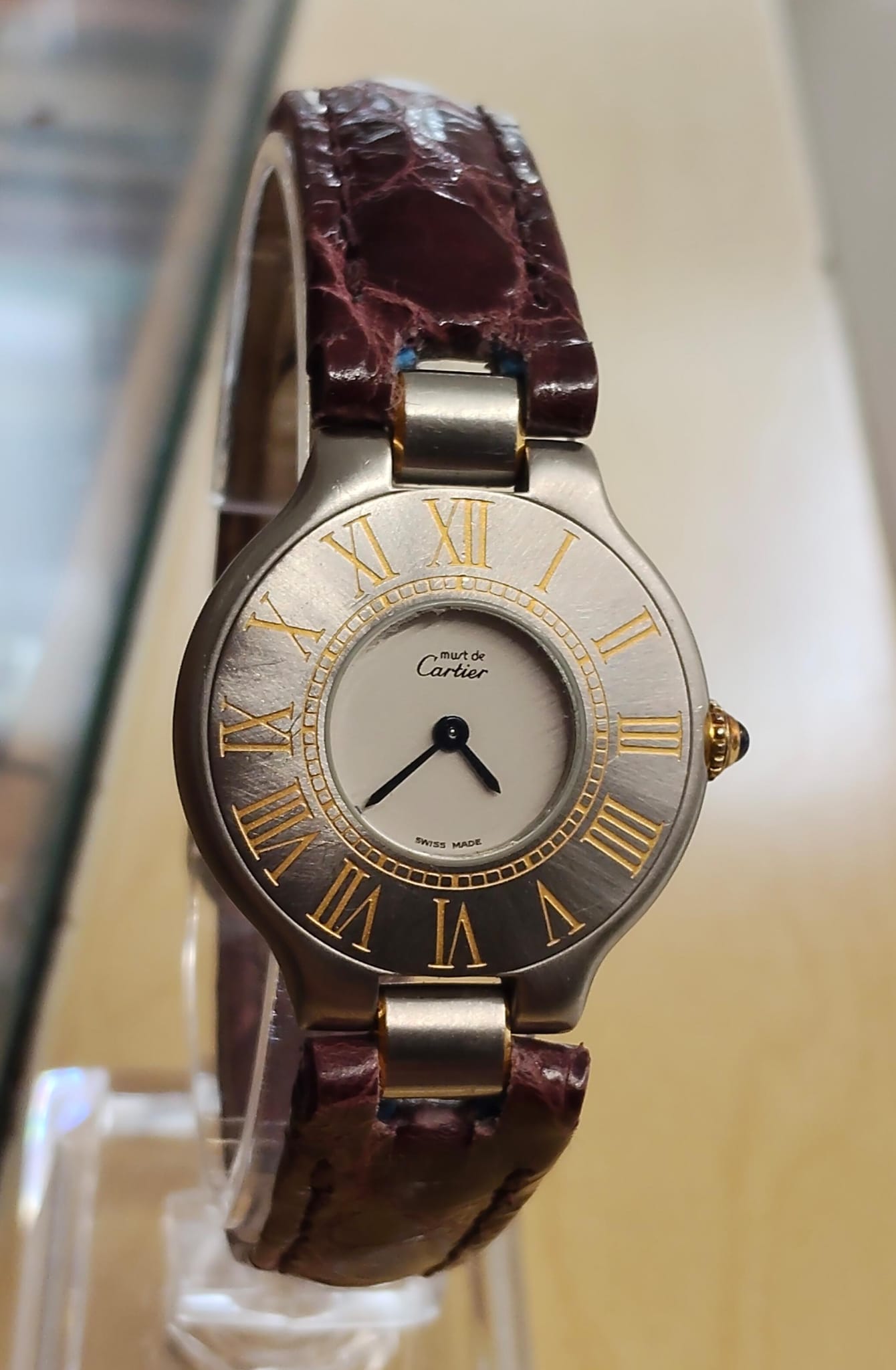
The Must de Cartier 21 represents a pivotal chapter in the Maison’s history, bridging the gap between high-jewelry artistry and accessible luxury. Introduced as part of the 'Must' collection—a line conceived in the 1970s to democratize the Cartier brand—the Model 21 emerged in the 1980s and 90s as a contemporary, sporty alternative to the more traditional Tank and Santos silhouettes. This specific example features the iconic bi-color aesthetic, characterized by a stainless steel case accented with gold-plated Roman numerals engraved directly onto the bezel. The design is a masterclass in minimalism, removing the traditional dial-based markers to create a cohesive, sculptural object that functions as both a timepiece and a piece of jewelry. Collectors value the Must de Cartier 21 for its distinct 'Neo-Vintage' appeal, offering a sleek, low-profile wrist presence that remains remarkably modern despite its decades-old design language. It is a watch that captures the essence of 1990s chic, favored by those who appreciate Cartier’s ability to manipulate geometry and typography into a functional art form. While widely produced during its era, finding well-preserved examples with crisp bezel engravings and original integrated lugs has become increasingly difficult, driving renewed interest among enthusiasts of the brand's heritage.
Technical Architecture
The engineering of the Must de Cartier 21 is centered around a slim, integrated architecture designed for maximum comfort and a streamlined profile. The case is constructed from high-grade stainless steel, featuring a circular silhouette with integrated, single-link lugs that transition seamlessly into the strap or bracelet. The most defining technical feature is the fixed bezel, which serves as the primary index; the Roman numerals are deeply engraved and filled with gold, surrounding a central, silvered dial. This dial is protected by a scratch-resistant sapphire crystal, ensuring durability and clarity. Inside, the watch is powered by a precision Swiss quartz movement, a choice that allowed Cartier to maintain the ultra-thin case dimensions that would have been impossible with a mechanical caliber of that era. The time-only display is operated via a signature beaded crown, often set with a blue synthetic spinel or sapphire cabochon, maintaining the brand’s design DNA. The case back is secured by screws, providing a modest water resistance suitable for daily wear but not intended for aquatic activities. The integration of the strap is proprietary, utilizing a specific screw-bar system that ensures the leather remains flush with the steel case, contributing to its distinct, jewelry-like appearance.
Historical Context
To understand the Must de Cartier 21, one must look at the financial landscape of the 1970s. Following the quartz crisis, Cartier sought to expand its reach beyond the ultra-wealthy elite. Under the leadership of Robert Hocq and Alain-Dominique Perrin, the 'Les Must de Cartier' line was launched in 1977. The name roughly translates to 'Cartier, these are a must,' signaling a shift toward lifestyle luxury. The Model 21 was a later evolution of this philosophy, arriving as a more youthful, avant-garde sibling to the 'Must de Cartier Tank.' It departed from the classicism of the early 20th-century designs, embracing the rounder, more integrated aesthetic of the late 20th-century sports-luxe movement. It was a watch designed for a generation that valued the Cartier name but desired a more robust, daily-wearable piece that didn't feel overly formal. Over time, the Model 21 helped solidify Cartier's position as a powerhouse in the fashion-forward luxury segment, proving that the brand's design language could adapt to changing tastes without losing its core identity. Today, it stands as a hallmark of the 'Must' era, representing a time when Cartier successfully navigated the transition from traditional watchmaking to a global luxury lifestyle brand.
Market Intelligence
The market for the Must de Cartier 21 is currently experiencing a notable resurgence, driven by the broader 'Neo-Vintage' trend and a growing appreciation for 80s and 90s design. Historically considered an entry-level piece, the Model 21 is now being re-evaluated by collectors as a significant design statement. Demand is particularly strong for examples in excellent cosmetic condition, as the gold-filled engravings on the bezel are prone to wear and fading over decades of use. From an investment perspective, the Must de Cartier 21 offers high liquidity; it is a recognizable 'status' watch that sells quickly on the secondary market. While it does not command the astronomical prices of solid gold Cartier vintage pieces, its value retention is remarkably stable. Supply is relatively healthy, but the number of 'collector-grade' pieces is dwindling, leading to a steady appreciation in price for mint-condition sets. The brand's current global strength—with Cartier often ranking as the second or third largest watch brand by revenue—provides a strong 'floor' for values. For those looking to enter the Cartier market, the Model 21 represents a high-alpha opportunity: a low entry price point with significant cultural capital and a high probability of continued relevance in the fashion-watch cross-over space.