WatchIQ
Gallet
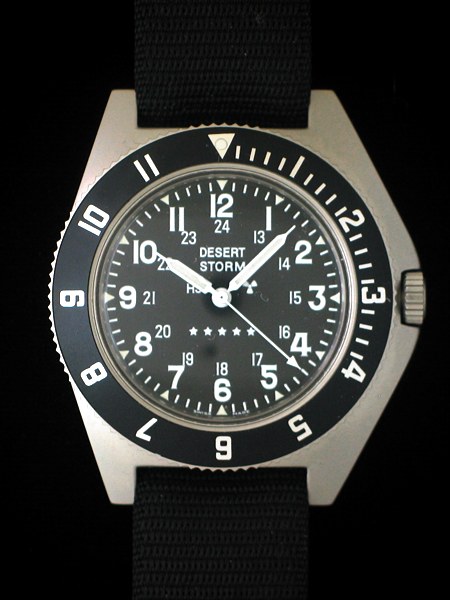
Gallet Adanac Navigator 'Desert Storm' (MIL-W-46374F)
Market Estimate
~$1,850
Specifications
Market Range
Gallet
Gallet Adanac Navigator 'Desert Storm' (MIL-W-46374F)
Market Estimate ~ $1,850
Market Range
Specifications
Executive Overview
The Gallet Adanac Navigator 'Desert Storm' represents a fascinating intersection of military necessity, geopolitical history, and horological utility. While Gallet is historically renowned for its high-end complications and chronographs, this specific model was born from a contract fulfillments for the United States and Canadian militaries. The 'Adanac' name—Canada spelled backward—was utilized by Gallet to navigate specific trade and bidding requirements for North American military contracts. This particular iteration is a commemorative and functional piece issued during the Gulf War era, specifically noted by the 'Desert Storm' text on the dial. Unlike standard military field watches, the Navigator was designed for personnel requiring timing capabilities across time zones and high-altitude environments, such as pilots and navigators. It features a distinct asymmetrical case design, intended to protect the crown without the need for traditional crown guards. For collectors, this watch is prized not for its luxury finishing, but for its authenticity as a 'tool watch' in the truest sense. It embodies the transition of military horology from mechanical movements to the high-accuracy quartz movements required for modern combat synchronization. Its presence in a collection signifies an appreciation for provenance and the rugged, unpretentious side of the Gallet heritage.
Technical Architecture
The engineering of the Gallet Adanac Navigator is defined by the MIL-W-46374F specification, a standard that demands extreme durability and legibility. The case is crafted from a heavy, matte-finished stainless steel, often referred to as parkerized, which eliminates reflections that could compromise a soldier's position. The most striking architectural feature is the asymmetrical case, which pulls the steel out on the right side to shield the crown from impact. The dial is a high-contrast matte black with two scales: a primary 12-hour track and an inner 24-hour military time track. Legibility in low light is handled by tritium gas tubes or paint, indicated by the 'H3' and radioactive symbol on the dial. Protecting the face is a thick, domed acrylic crystal, chosen for its shatter-resistant properties compared to sapphire. The bezel is a bidirectional friction-fit ring with a 12-hour scale, allowing the wearer to track a second time zone—a critical feature for flight crews and overseas deployments. Under the hood, the watch utilizes a high-torque Swiss quartz movement, specifically chosen for its ability to maintain accuracy under the G-forces and vibrations of military aircraft. The fixed spring bars are a final nod to its tactical roots, ensuring that even if one part of the strap fails, the watch remains secured to the wrist via a nylon NATO or Zulu strap.
Historical Context
To understand the Gallet Adanac, one must look at the late 20th-century landscape of military procurement. Gallet, the world's oldest watchmaking house, has a long history of supplying timing instruments to the world's armed forces, including the famous Flight Officer chronograph. In the late 1980s and early 1990s, the brand secured contracts with the U.S. Department of Defense. Because the contracts were often routed through Canadian entities, the 'Adanac' branding was adopted. This specific 'Desert Storm' variant was produced during the 1990-1991 period to coincide with Operation Desert Shield and Desert Storm. It sits in a lineage of 'Navigator' watches that includes the Marathon Steel Navigator, which shares a nearly identical case profile. However, the Gallet-signed versions and the Adanac-branded pieces are considered the quintessential examples of this design language. This model marked the twilight of the era where major Swiss houses directly supplied specialized equipment to infantry and flight crews before the market shifted toward more generic, mass-produced digital alternatives. It serves as a bridge between the mechanical military icons of the Vietnam era and the digital tactical gear of the 21st century.
Market Intelligence
The market for military Gallet/Adanac watches has seen a significant uptick in interest as vintage military-spec (Mil-Spec) collecting moves into the mainstream. While standard Adanac Navigators are uncommon, the 'Desert Storm' dial variant is a specific sub-niche that commands a premium due to its direct historical link to the Gulf War. From an investment perspective, these watches offer a lower barrier to entry than a Rolex Milgauss or a Tudor Submariner, yet they provide equivalent historical authenticity. Supply is naturally capped; these were produced for a specific conflict and many were lost or destroyed in service. On the secondary market, value is heavily dictated by the condition of the matte case finish and the original tritium patina. Collectors look for 'unmolested' examples that haven't had their crystals replaced with modern sapphire or their dials relumed. Liquidity is moderate; while not as instantly recognizable as a Speedmaster, the 'Desert Storm' Navigator has a dedicated following among military historians and 'tool watch' purists. Long-term value retention is supported by the Gallet brand name, which continues to rise in prestige among high-end collectors, creating a 'halo effect' for even their more utilitarian quartz offerings.