WatchIQ
Gallet
Gallet Flying Officer Chronograph (First Generation)
Market Estimate
~$8,500
Specifications
Market Range
Gallet
Gallet Flying Officer Chronograph (First Generation)
Market Estimate ~ $8,500
Market Range
Specifications
Executive Overview
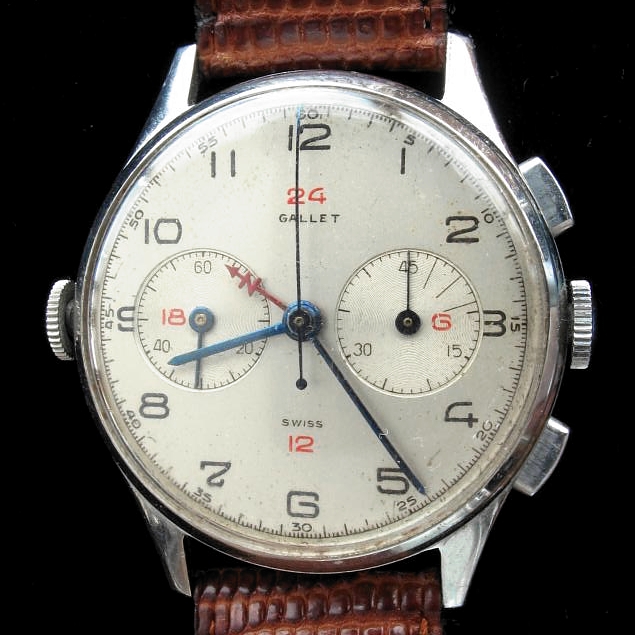
The Gallet Flying Officer stands as one of the most historically significant chronographs of the 20th century, specifically engineered for the rigors of aerial warfare and international navigation. Originally commissioned by Senator Harry S. Truman for United States Air Force pilots during World War II, this timepiece was the world's first chronograph to feature a rotating 12-hour bezel, allowing pilots to calculate changes in time zones instantly. This specific example represents the early, purest iteration of the design, characterized by its utilitarian dial layout and the distinctive 'red 24' and 'red 12' markings which aided in 24-hour military time conversion. Collectors prize the Flying Officer not just for its military provenance, but for its role in pioneering the 'World Timer' complication in a compact, wearable format. Unlike the oversized pilot watches of the era, Gallet focused on precision and legibility within a standardized case size, making it a favorite among navigators who required split-second accuracy for dead reckoning. Today, finding a first-generation model with an original dial and correct handset is increasingly difficult, as many were lost in service or heavily modified over the decades. It represents a bridge between high-precision Swiss watchmaking and the desperate functional requirements of mid-century aviation, making it a cornerstone for any serious military or chronograph-focused collection.
Technical Architecture
At the heart of this Gallet Flying Officer is the legendary Venus Calibre 150, a column-wheel manual-wind chronograph movement revered for its durability and smooth pusher engagement. The movement features 17 jewels and operates at 18,000 vibrations per hour, a standard for the era that offered a balance between accuracy and longevity. The case is constructed from high-grade staybrite stainless steel, featuring a screw-down caseback—a rarity for 1940s chronographs—which provided superior protection against dust and moisture. One of its most defining technical features is the bi-directional rotating bezel, which, when used in conjunction with the 12-hour dial, allows the wearer to track a second time zone. The dial is a masterclass in information density; it features a 45-minute recorder at 3 o'clock and a running seconds sub-dial at 9 o'clock. The blued steel hands are heat-treated to prevent corrosion and provide high contrast against the silvered dial. The crystal is a domed hesalite acrylic, chosen for its shatter-resistant properties in cockpit environments. The lug design is sharp and tapered, utilizing a 18mm spacing that was standard for military-issued straps of the 1940s. Every element of the architecture, from the oversized winding crown to the pump pushers, was designed to be operated while wearing flight gloves, emphasizing its purpose-built nature.
Historical Context
Gallet, the world's oldest watch and clock making house with origins dating back to 1466, has a long history of professional-grade timing instruments. The Flying Officer was introduced in 1939, just as global tensions were escalating into World War II. Its development was spurred by the need for a flight officer to manage navigation across multiple longitudes. The model gained legendary status when it was famously worn by Harry S. Truman during his time as a Senator and later as President of the United States. This specific version, often referred to as the 'Truman Gallet' style, predates the later 'MultiChron' branding and represents the era when Gallet was the primary supplier of chronographs to various Allied air forces. It replaced simpler single-button chronographs, offering more versatility through its dual-pusher system and rotating bezel. In the broader context of horology, the Flying Officer laid the groundwork for the GMT watches that would become ubiquitous in the jet age of the 1950s. It was an essential tool that transitioned from the wrists of combat pilots to the cockpits of early commercial aviation, cementing Gallet's reputation as the 'Pilot's Watchmaker.' Its influence can be seen in later icons like the Breitling Navitimer, yet the Gallet remains the progenitor of the compact, multi-timezone pilot's chronograph.
Market Intelligence
The market for vintage Gallet chronographs has seen a significant upward trajectory over the last decade, as collectors have shifted focus from mainstream giants like Rolex and Omega toward 'scholar' brands with deep military and technical pedigree. The Flying Officer is the flagship of this movement. Demand is driven by the model's direct link to WWII aviation and its association with Harry Truman, which provides a unique cross-collectible appeal between horology and political history. Secondary market behavior shows that 'honest' examples—those with original dials, unpolished cases, and correct Venus 150 movements—command a substantial premium. Supply is naturally constrained; while Gallet produced the Flying Officer for several decades, the early 1940s versions are increasingly scarce. From an investment perspective, the Flying Officer is considered a 'blue chip' vintage chronograph. It possesses high value retention due to its historical importance and the relatively small number of surviving specimens in good condition. While liquidity is slightly lower than a high-volume vintage Rolex, the niche community of Gallet enthusiasts is highly active and willing to pay top market prices for well-documented pieces. The brand's independence and lack of modern mass-production also protect the vintage market from the brand dilution often seen in larger conglomerates.