WatchIQ
Gallet
Gallet MultiChron 12 (Vintage Chronograph)
Market Estimate
~$4,500
Specifications
Market Range
Gallet
Gallet MultiChron 12 (Vintage Chronograph)
Market Estimate ~ $4,500
Market Range
Specifications
Executive Overview
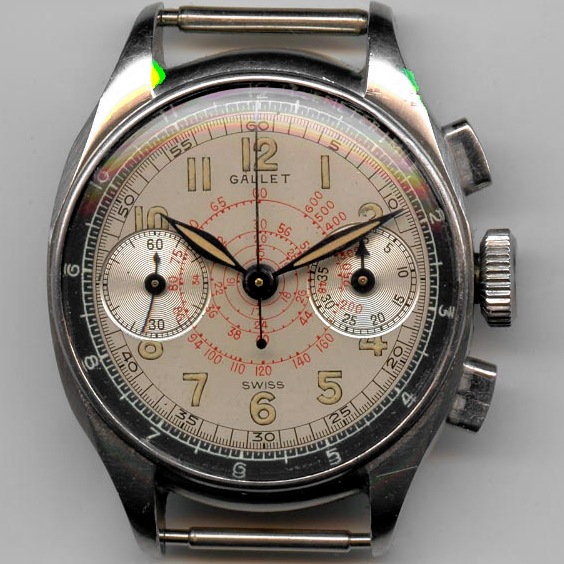
The Gallet MultiChron 12 represents a pinnacle of mid-century tool watch engineering, hailing from a brand frequently cited as the oldest watchmaking house in the world. This specific reference is a masterclass in functional complexity, featuring a sophisticated multi-scale dial that served the needs of professionals ranging from military officers to scientific researchers. Collectors prize the MultiChron 12 not only for its historical pedigree but for its exceptional legibility and the high-grade movements housed within its robust steel architecture. Unlike many of its contemporaries that leaned toward decorative aesthetics, Gallet maintained a strict adherence to 'form follows function,' making it a darling of the vintage horology community. The presence of a snail-style tachymeter scale in the center of the dial indicates a primary utility for measuring speed over a fixed distance, a critical requirement in the post-WWII era of rapid industrial and automotive expansion. Its enduring appeal lies in its authentic patina and the tactile mechanical connection offered by its manual-wind caliber, making it a cornerstone for those building a portfolio of significant 20th-century chronographs.
Technical Architecture
At the heart of this MultiChron 12 is a manual-winding column-wheel chronograph movement, typically the lauded Venus 150 or the legendary Valjoux 72, depending on the specific production batch. These movements are celebrated for their reliability and smooth pusher engagement. The case is constructed from high-grade stainless steel, featuring sharp, faceted lugs and a screw-down or snap-back case design that offered respectable water resistance for the period. The dial is a complex arrangement of silvered or cream surfaces, featuring two sub-dials—a 30-minute counter at 3 o’clock and a running seconds sub-dial at 9 o’clock. The central 'snail' tachymeter scale is printed in a contrasting red or blue, allowing for accurate speed calculations down to very low velocities. The hands are traditionally heat-blued or luminous-filled steel, protected by a high-domed hesalite (acrylic) crystal that adds significant warmth and character to the watch's profile. The oversized 'winding crown' and rectangular or round pump pushers are ergonomically designed for ease of use, even while wearing gloves, reflecting its origins as a utility instrument.
Historical Context
Gallet’s history stretches back to the 15th century, but it was during the mid-20th century that the firm solidified its reputation as the premier producer of professional-grade chronographs. The MultiChron series was introduced as a specialized tool for industrial and military applications. Specifically, the MultiChron 12 was a predecessor to the famous 'Jim Clark' Gallet, famously worn by the legendary Formula 1 driver. During the 1940s and 50s, Gallet supplied various Allied forces and professional organizations with these timepieces, often outperforming more expensive rivals in rigorous testing. This model was a direct response to the need for a versatile instrument that could track elapsed time, calculate speed, and measure distance (telemeter). It represents the transition from the oversized aviator watches of the early 1940s to the more refined, wearable sport-chronographs that would dominate the 1960s. Its placement in history is as a bridge between the era of the pocket watch and the modern era of the luxury sports chronograph.
Market Intelligence
The market for vintage Gallet chronographs has seen a significant upward trajectory over the last decade. As collectors have been priced out of early Rolex Daytonas and Universal Genève Compaxes, Gallet has emerged as the 'smart money' alternative, offering equivalent mechanical quality and richer professional history. Demand is particularly high for examples with original, un-refinished dials and sharp cases that retain their factory geometry. The secondary market behavior for the MultiChron 12 is characterized by high retention and low supply; these pieces are often held in private collections for long durations. While Gallet as a brand does not have the massive marketing machinery of larger conglomerates, its strength lies in a dedicated, informed collector base. Supply is naturally capped by the age of the pieces and the fact that Gallet was a specialist manufacturer rather than a mass-market producer. Long-term value retention is considered strong, as the brand’s historical importance is increasingly recognized by major auction houses and horological scholars.