WatchIQ
Gallet
Gallet MultiChron 12 'Clamshell' Chronograph
Market Estimate
~$6,500
Specifications
Market Range
Gallet
Gallet MultiChron 12 'Clamshell' Chronograph
Market Estimate ~ $6,500
Market Range
Specifications
Executive Overview
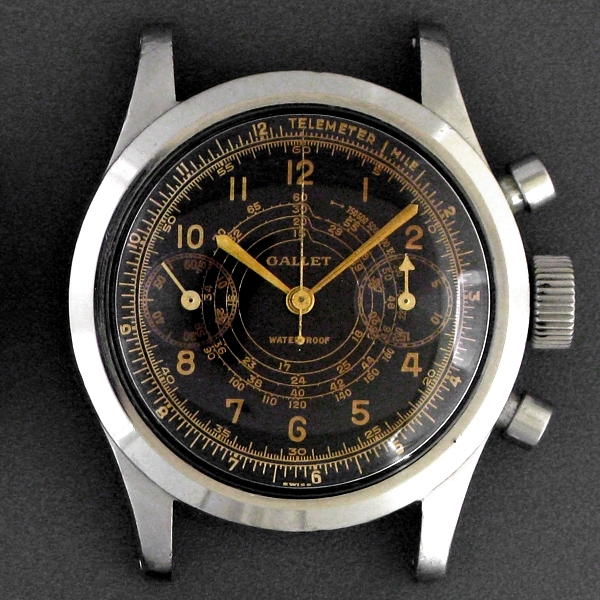
The Gallet MultiChron 12, specifically the 'Clamshell' variant, represents a pinnacle of mid-20th-century tool watch engineering and is a cornerstone of the Gallet heritage. This particular model, distinguished by its black 'gilt' multiscale dial, was designed for professionals requiring precise calculations in the field, from pilots to military officers. Known as the world's first water-resistant chronograph, the MultiChron 12 utilizes a unique four-screw case design that compresses the gasket to ensure hermetic sealing, a revolutionary feat for the 1940s. Collectors prize this model for its exceptional legibility and the complexity of its dial, which features both telemeter and tachymeter scales. The 'Waterproof' designation on the dial is not merely a marketing claim but a testament to Gallet's pioneering role in chronometric durability. As a brand that has historically supplied timing instruments to various world militaries and aviation pioneers, this model carries a pedigree of functional excellence. The aesthetic appeal of the aged radium numerals against the deep black dial, combined with the syringe-style hands, creates a visual profile that is both rugged and sophisticated. In the current vintage market, the MultiChron 12 is regarded as a 'scholar’s watch,' appealing to those who appreciate the technical nuances of movement architecture and the historical significance of the Gallet name, which remains one of the world's oldest watchmaking houses.
Technical Architecture
The technical foundation of this MultiChron 12 is centered around the legendary Excelsior Park 40 (EP40) manual-wind movement. This caliber is celebrated for its column-wheel architecture, providing a tactile and precise engagement of the chronograph functions that is often preferred over later cam-actuated systems. The movement features a high level of finishing and a robust power reserve, tailored for the reliability required in professional environments. The case construction is the famous 'Clamshell' design, patented by Schmitz Frères, which uses four screws located on the underside of the lugs to pull the bezel and case back together, sandwiching the crystal and gasket for superior water resistance. The case is crafted from high-grade stainless steel with sharp, faceted lugs that provide a significant wrist presence despite its vintage dimensions. The dial is a masterpiece of information density, featuring a snail-style tachymeter scale in the center and a telemeter scale on the outer track, allowing the user to measure both speed and distance based on sound. Protected by a domed Hesalite acrylic crystal, the dial utilizes Radium-based luminous material for the Arabic numerals and hands, which typically develops a rich, warm patina over decades. The oversized winding crown and 'mushroom' style pump pushers are ergonomically designed for ease of use, even when wearing flight gloves, emphasizing the watch's utilitarian origins.
Historical Context
Gallet’s history stretches back to the 15th century, but its 20th-century contributions to the chronograph are perhaps its most significant. The MultiChron 12 was introduced at a time when the world was embroiled in conflict, and the need for reliable, water-resistant timing instruments was at an all-time high. This model followed the success of the MultiChron 30 and preceded the famous 'Flying Officer' chronograph commissioned by Harry S. Truman. By integrating the Schmitz Frères waterproof case, Gallet solved one of the primary weaknesses of early chronographs: vulnerability to moisture and dust. This innovation allowed the watch to be used in harsh maritime and tropical environments, significantly expanding its utility. Throughout the 1940s and 50s, Gallet became a preferred supplier for the Swiss Air Force and various Allied forces, cementing its reputation for accuracy and durability. The MultiChron 12 also marked a period of close collaboration between Gallet and Excelsior Park, a partnership that produced some of the most respected chronograph calibers in horological history. Today, this model is viewed as a precursor to the modern professional sports watch, bridging the gap between delicate pocket watch-derived instruments and the rugged tool watches of the 1960s. Its survival in such crisp condition is a testament to the original build quality and the 'Waterproof' engineering that protected the delicate movement for over three-quarters of a century.
Market Intelligence
The market for vintage Gallet chronographs has seen a significant upswing over the last decade as collectors pivot away from mainstream brands toward 'insider' favorites with genuine military and technical provenance. The MultiChron 12 with a black gilt dial is particularly sought after, often commanding a premium over the more common silver-dial variants. Supply is inherently limited; while Gallet produced these in reasonable numbers for the era, many were lost or damaged due to their heavy use in professional and military settings. The secondary market behavior for the 'Clamshell' models shows strong value retention, with prices steadily climbing as the availability of unpolished examples with original radium dials diminishes. From an investment perspective, Gallet represents a high 'value-to-prestige' ratio compared to brands like Heuer or Universal Genève, though the gap is rapidly closing. Demand is driven primarily by European and North American collectors who value the Excelsior Park movement and the unique case architecture. Liquidity is high for well-documented, original examples, as they are frequently featured in high-end horological auctions and boutique vintage dealerships. The brand's lack of a modern mass-market presence actually bolsters its 'cult' status, ensuring that the primary interest comes from educated enthusiasts rather than speculative flippers, leading to a more stable and organic price appreciation curve.