WatchIQ

Gallet
Gallet MultiChron 30 'Clamshell' Chronograph
Market Estimate
~$4,500
Specifications
Market Range
Gallet
Gallet MultiChron 30 'Clamshell' Chronograph
Market Estimate ~ $4,500
Market Range
Specifications
Executive Overview
The Gallet MultiChron 30 is a cornerstone of mid-century military and professional horology, representing a period when Gallet was the premier supplier of precision timing instruments to allied forces and specialized professionals. This specific iteration, often referred to by collectors as the 'Clamshell,' features one of the world's earliest water-resistant chronograph case designs. Unlike modern screw-down casebacks, the Clamshell utilizes a sophisticated four-screw compression system that secures the bezel and caseback against a central gasket, a patented innovation by Galvin Manufacturing. This model is highly prized by collectors for its pure utilitarian aesthetic, featuring a high-contrast 'black gilt' or matte black dial with luminous Arabic numerals and a distinctive railroad minute track. As the world's oldest watch brand, Gallet's execution of the MultiChron 30 exemplifies the transition of the chronograph from a delicate laboratory tool to a rugged, field-ready instrument. The presence of the 'Waterproof' signature on the dial—a bold claim for the 1940s—signifies its elite status among contemporary chronographs of the era. For the serious vintage enthusiast, the MultiChron 30 is not merely a timepiece but a mechanical artifact that survived the rigors of the mid-20th century, offering a tactile connection to the golden age of tool watch engineering.
Technical Architecture
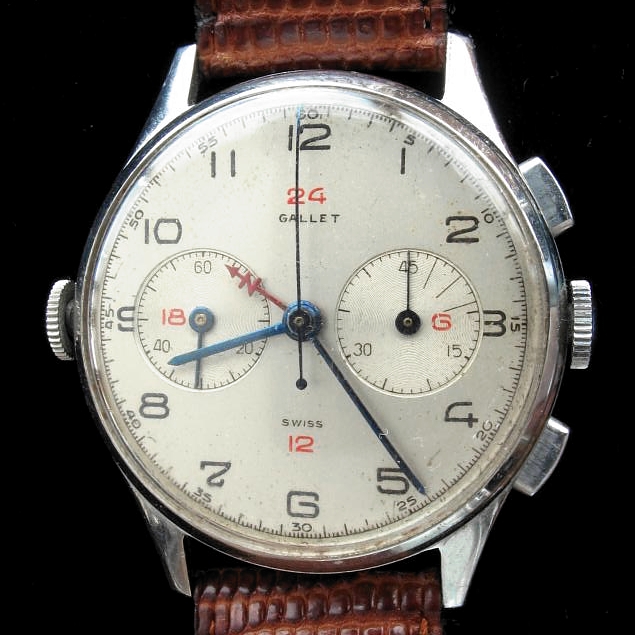
At the heart of this MultiChron 30 lies the esteemed Excelsior Park Calibre 42, a manual-wind movement renowned for its exceptional finishing and reliability. Gallet maintained a legendary partnership with Excelsior Park, ensuring their chronographs utilized movements that were often superior to those found in more expensive contemporary brands. The 34.5mm stainless steel case is defined by the Brevet 189190 'Clamshell' architecture. This system employs four screws located on the underside of the lugs to compress the upper and lower case sections together, creating a hermetic seal that was revolutionary for the time. The dial is a masterclass in functional design, featuring a bi-compax layout with a 30-minute counter at 3 o'clock and running seconds at 9 o'clock. The crystal is a high-domed hesalite acrylic, designed to withstand pressure without shattering. The pushers are of the 'pump' variety, integrated into the case with internal gaskets to maintain water resistance. The lug width is typically 18mm, featuring a drilled-through design that allows for rapid strap changes in the field. Every component, from the blued steel hands to the internal pillar wheel of the movement, reflects a level of mechanical integrity that has allowed these watches to remain functional eighty years after their initial assembly.
Historical Context
Introduced in the late 1930s and seeing extensive production through the 1940s, the MultiChron 30 Clamshell arrived at a pivotal moment in history. During World War II, Gallet was a primary contractor for the United States and British military forces, particularly for pilots and navigators who required precise, water-resistant timing. The Clamshell case was a direct response to the vulnerability of early chronographs to moisture and dust, which frequently fouled the delicate movements during combat operations. This model preceded the more famous 'Flying Officer' and 'MultiChron 12' models, serving as the experimental ground for Gallet’s waterproof technology. In the broader scope of watchmaking, the MultiChron 30 helped establish the 'Tool Watch' category, proving that a high-complication chronograph could be encased in a rugged, survivable shell. Its influence can be seen in later diving and racing chronographs of the 1950s and 60s. Today, it stands as a testament to Gallet's historical dominance in the field of chronometry, a brand that once outpaced rivals like Rolex and Breitling in the development of specialized timing complications for professional use.
Market Intelligence
The market for vintage Gallet chronographs has seen a significant upward trajectory over the last decade, driven by a growing appreciation for 'intellectual' vintage watches. Unlike mass-market luxury brands, Gallet appeals to a sophisticated subset of collectors who value movement quality and historical authenticity over brand recognition alone. The MultiChron 30 Clamshell is currently in a 'strong hold' phase; supply is tightening as examples in original, unpolished condition are increasingly absorbed into permanent private collections. Demand is particularly high for black dial variants with original radium or tritium luminescence. From an investment perspective, the MultiChron 30 offers a lower entry price than a comparable Universal Genève Compax but provides nearly identical horological value and historical importance. Secondary market behavior shows that while prices for common vintage pieces have stabilized, 'Clamshell' cases with sharp lug profiles and original movements command a significant premium. The brand's lack of a modern mass-market presence actually serves to insulate its vintage pieces from the volatility of modern luxury trends, making it a stable asset for long-term preservation of value.