WatchIQ
Gallet
Gallet MultiChron 30 'Clamshell' Chronograph
Market Estimate
~$6,500
Specifications
Market Range
Gallet
Gallet MultiChron 30 'Clamshell' Chronograph
Market Estimate ~ $6,500
Market Range
Specifications
Executive Overview
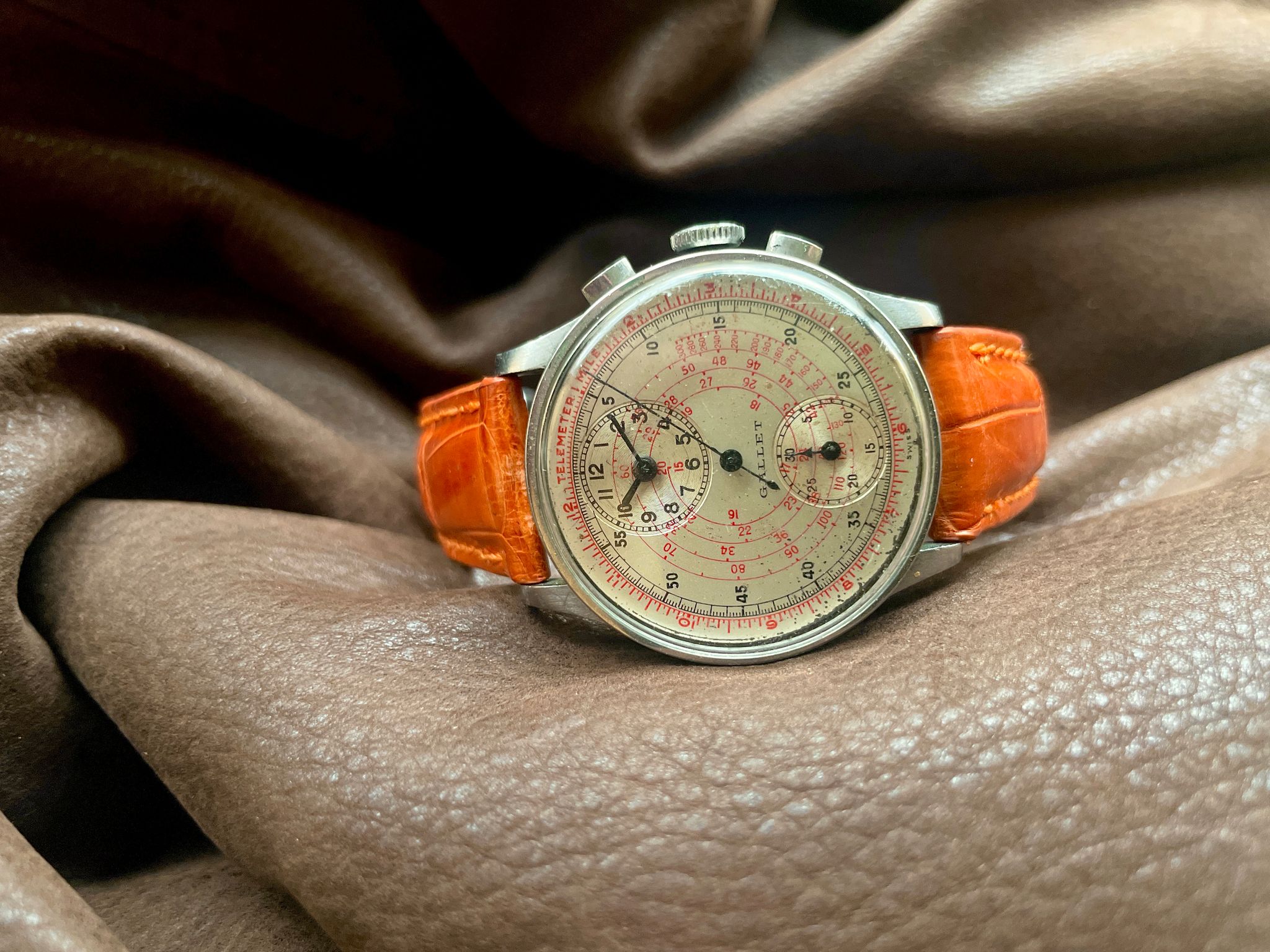
The Gallet MultiChron 30 represents a pinnacle of mid-century tool watch engineering, specifically the era of the 'Clamshell' or 'Brevet 189190' case. This particular model is a masterclass in functional complexity, featuring a highly sought-after multi-scale dial that served as a critical instrument for military and scientific professionals in the 1940s. Gallet, as the world's oldest watchmaking house, utilized the MultiChron series to establish a standard for chronograph precision that remains a benchmark for vintage collectors today. What makes this specific iteration special is the combination of the red telemeter scale and the spiral tachymeter 'snail' scale at the center of the dial. These scales allowed the wearer to measure both distance based on sound and speed over a fixed distance, effectively turning the wrist into a portable computer. For the serious horologist, the MultiChron 30 isn't just a timepiece; it is a survivor of a period where Gallet dominated the cockpit and the battlefield. Its presence in a collection signals an appreciation for pure mechanical utility and the innovative waterproof case designs that predated the modern diver. The aesthetic appeal of the aged patina on the silvered dial, contrasted with the sharp, utilitarian stainless steel case, creates a visual narrative of mid-century adventure and technical prowess.
Technical Architecture
The engineering core of this MultiChron 30 is the legendary Excelsior Park Calibre 40, a manual-wind chronograph movement renowned for its robustness and finishing. Unlike many contemporary movements of the 1940s, the EP40 was purpose-built for high-frequency use in demanding environments. The architecture of the watch is defined by the 'Clamshell' case design, patented by Gallet's supplier, Gallet & Cie, under Swiss Patent 189190. This innovative construction utilizes four screws located on the underside of the lugs to compress the bezel and case back against a lead gasket, creating one of the world's first truly water-resistant chronograph housings. The case is crafted from high-grade staybrite stainless steel, featuring sharp, faceted lugs and a thin bezel that maximizes dial real estate. The dial itself is a complex arrangement of printed scales: a black minute track, a red telemeter scale for distance calculation, and a central 'snail' tachymeter for measuring low speeds. The crystal is a high-domed hesalite acrylic, which provides the characteristic vintage warmth and distortion at the edges. The twin-register layout provides a 45-minute counter at 3 o'clock and a running seconds sub-dial at 9 o'clock, powered by a horizontal clutch and column wheel mechanism that ensures a crisp, tactile engagement of the chronograph pushers.
Historical Context
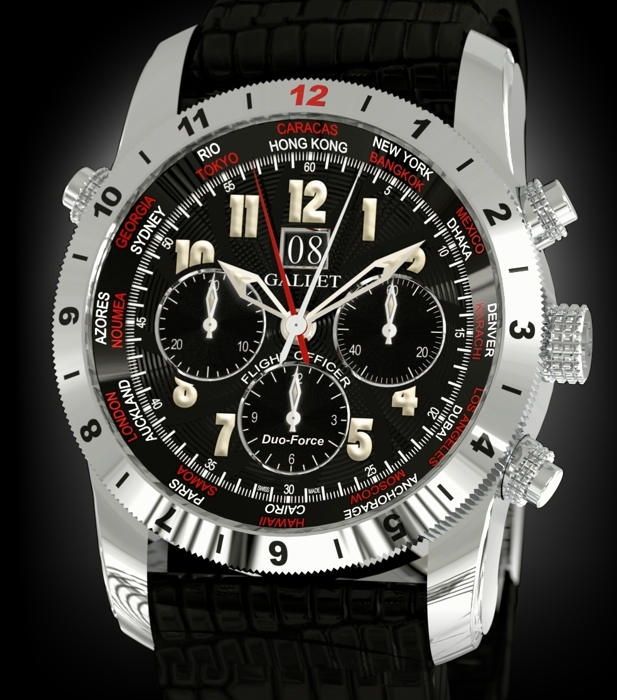
Introduced in the late 1930s and seeing heavy service throughout the 1940s, the Gallet MultiChron 30 was a direct response to the needs of the Allied forces and professional aviators during World War II. It replaced earlier, non-water-resistant chronographs that were prone to failure in humid or wet conditions. Gallet’s introduction of the Clamshell case was a revolutionary step in horological history, as it addressed the primary weakness of chronographs: the vulnerability of the pushers and case seams to moisture. This model sits within a lineage of 'MultiChron' watches that includes the famous Flight Officer, commissioned by Harry S. Truman for United States Air Force pilots. The MultiChron 30 specifically bridged the gap between purely military-issued equipment and professional civilian instruments. By the mid-1940s, Gallet had solidified its reputation as the premier manufacturer of chronographs, supplying movements and designs that would influence the industry for decades. The transition from the Clamshell design to the more common screw-down case backs in the 1950s makes these early 1940s variants particularly significant to historians, representing a unique experimental phase in the quest for the ultimate waterproof sports watch.
Market Intelligence
The market for vintage Gallet chronographs has seen a significant upward trajectory over the last decade, driven by a growing 'collector-scholar' class that values technical innovation over brand marketing. The MultiChron 30 with a Clamshell case is a blue-chip vintage asset. Unlike mass-produced luxury watches, the supply of high-quality Gallet chronographs is strictly finite, as many were lost or destroyed during military service. Demand is currently bolstered by the 'small watch' trend and a resurgence in appreciation for mid-century tool aesthetics. Secondary market behavior shows that examples with original, unpolished cases and 'snail' dials command a significant premium, often outperforming more famous brands like Heuer or Breitling from the same era in terms of percentage growth. The brand strength of Gallet is unique; while it lacks the global advertising presence of Rolex, its historical pedigree and the cult following of its 'Flight Officer' and 'MultiChron' lines ensure high liquidity among serious vintage dealers and auction houses. Long-term value retention is considered excellent, as these pieces are increasingly viewed as historical artifacts rather than mere accessories. Investors should look for sharp case lines and the presence of the original Excelsior Park movement to ensure maximum appreciation.