WatchIQ
Junghans
Junghans Meister Chronoscope (Gold PVD)
Market Estimate
~$2,100
Specifications
Market Range
Junghans
Junghans Meister Chronoscope (Gold PVD)
Market Estimate ~ $2,100
Market Range
Specifications
Executive Overview
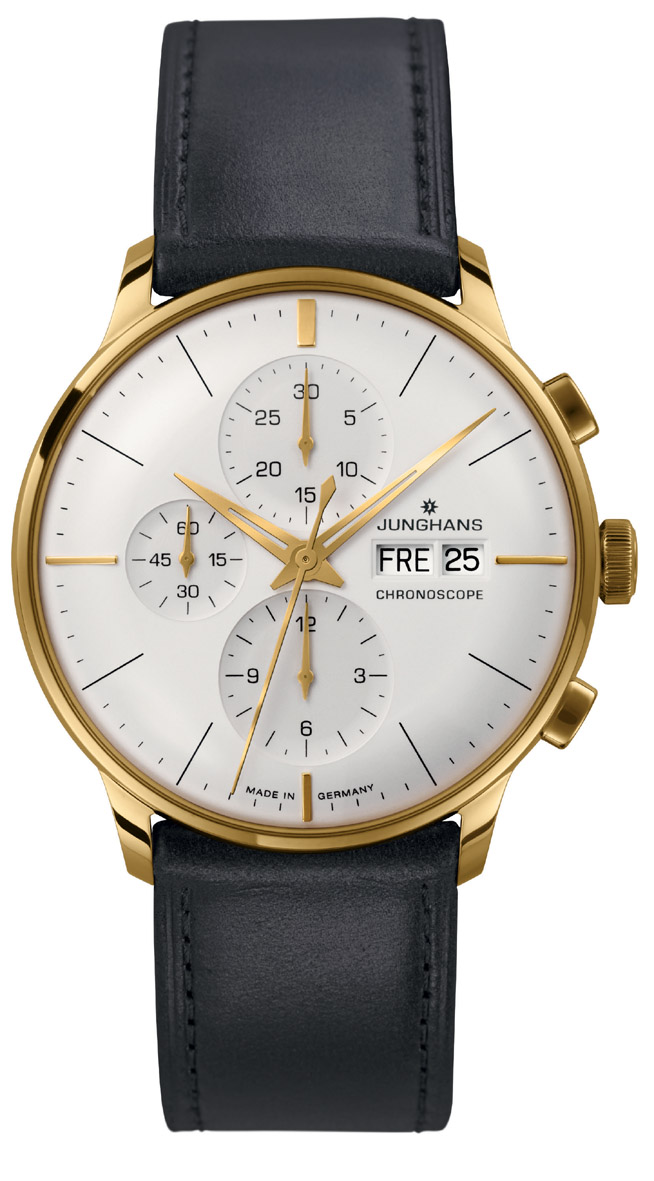
The Junghans Meister Chronoscope represents the pinnacle of German neoclassical watchmaking, blending the utilitarian precision of the Black Forest with an elegant, mid-century aesthetic. This specific iteration, featuring a yellow gold PVD-coated case and a matte silver-plated dial, serves as a sophisticated alternative to the brand’s more minimalist Max Bill collection. While the Max Bill focuses on the strict tenets of Bauhaus design, the Meister line draws from Junghans’ own historical archives of the 1930s and 1950s, offering a more contoured, architectural approach to the chronograph. Collectors gravitate toward the Meister Chronoscope for its distinctive 'bowl-shaped' recessed sub-dials and the dramatic curvature of its plexiglass or sapphire crystal, which creates a unique play of light across the dial. It is a watch that communicates a high level of intellectual discernment; it is not a loud statement piece, but rather a masterclass in proportion and legibility. The inclusion of a day-date complication in German (Wochentag) further cements its identity as a product of authentic Teutonic engineering. In an era of oversized and aggressive sports watches, the Meister Chronoscope remains a bastion of refined masculinity, offering a versatile wearing experience that transitions seamlessly from formal attire to smart-casual environments.
Technical Architecture
At the heart of the Meister Chronoscope lies the Caliber J880.1, a robust self-winding movement based on the venerable Valjoux 7750 architecture. This choice ensures long-term serviceability and chronometric reliability, featuring a 48-hour power reserve and a vibration frequency of 28,800 semi-oscillations per hour. The case construction is particularly noteworthy for its slim profile despite the modular nature of a vertical-clutch chronograph; this is achieved through the use of highly domed crystals and a tapered case back that sits comfortably against the wrist. The 40.7mm case is treated with a high-grade yellow gold PVD coating, providing the warmth of precious metal with the scratch resistance of steel. The dial is a work of art in three dimensions, featuring deep-set sub-dials for the 30-minute counter, 12-hour counter, and small seconds. The hands are diamond-cut and treated with environmentally friendly Super-Luminova for low-light visibility. Depending on the specific reference, the watch is protected by either a hard Plexiglass with Sicralan coating—a historical nod that offers a warmer vintage glow—or a double-domed anti-reflective sapphire crystal for modern durability. Water resistance is rated at 3 to 5 bar, reflecting its status as a dress chronograph rather than a tool watch.
Historical Context
The 'Meister' designation is one of the oldest and most respected in the Junghans catalog, first appearing in the 1930s to denote the company's highest grade of movements and finishes. During the 1950s, the Meister line became the definitive expression of the German 'Wirtschaftswunder' or economic miracle, symbolizing the return of prosperity and precision manufacturing. This modern Chronoscope is a direct descendant of those mid-century icons. While Junghans is often synonymous with the Bauhaus movement due to their collaboration with Max Bill in the 1960s, the Meister collection represents the brand’s internal design language—one that is slightly more ornate and classic than the sterile lines of Bauhaus. This model occupies a vital space in horological history as a bridge between the traditional watchmaking of the early 20th century and the functionalist demands of the modern era. It serves as a reminder that German watchmaking, centered in Schramberg, developed a parallel but distinct evolution to the Swiss industry, prioritizing a specific type of ergonomic elegance and factory-floor reliability that remains highly influential today.
Market Intelligence
From an investment and market perspective, the Junghans Meister Chronoscope is classified as a 'stable value' asset. It does not typically experience the volatile speculative bubbles seen in stainless steel integrated-bracelet sports watches, making it a safer, albeit slower-growing, addition to a collection. Its value retention is remarkably strong within the 'accessible luxury' segment, largely because Junghans maintains a disciplined production volume and avoids heavy discounting. The secondary market for the Meister Chronoscope is liquid, with high demand from enthusiasts who value German engineering over Swiss branding. The gold PVD variants hold their value well among buyers looking for a classic aesthetic without the five-figure entry price of solid 18k gold. Brand strength for Junghans has seen a significant uptick in North American and Asian markets over the last decade, driven by a growing appreciation for 'New Minimalism' and heritage-driven design. As an asset, the Meister Chronoscope is favored for its 'entry-level blue chip' status—it is a respected choice that signals horological maturity and is unlikely to ever go out of style, ensuring a consistent floor for its resale price.
.JPG.JPG)