WatchIQ
Longines
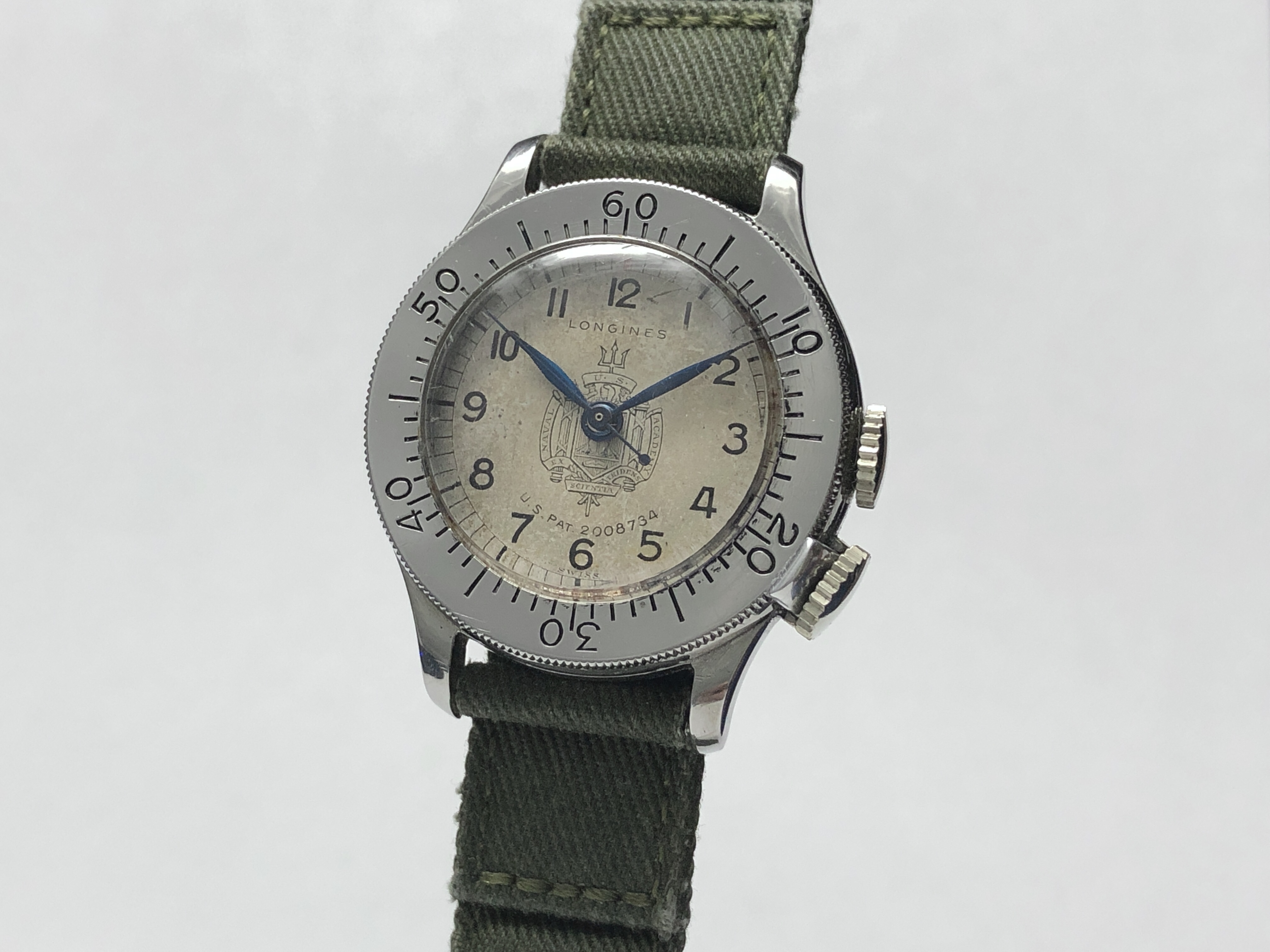
Longines Weems Second-Setting Watch (U.S. Naval Academy Edition)
Market Estimate
~$12,500
Specifications
Market Range
Longines
Longines Weems Second-Setting Watch (U.S. Naval Academy Edition)
Market Estimate ~ $12,500
Market Range
Specifications
Executive Overview
The Longines Weems Second-Setting watch represents a pinnacle of functional horology from the golden age of aviation and naval navigation. Developed in collaboration with Captain Philip Van Horn Weems of the U.S. Navy, this specific iteration is a highly coveted artifact featuring the United States Naval Academy (USNA) crest prominently displayed on the dial. Unlike standard timepieces of the era, the Weems was designed as a precision tool to solve the problem of 'second-setting.' In an age before hacking movements were common, the rotating bezel allowed navigators to synchronize their watch with a radio time signal without stopping the movement, a critical requirement for accurate celestial navigation. This particular model, characterized by its dual-crown system and aged parchment dial, serves as a bridge between military necessity and Swiss craftsmanship. For the serious collector, it is more than a watch; it is a piece of mid-century military intelligence. The presence of the USNA crest suggests a provenance linked to commissioned officers or graduates of Annapolis, adding a layer of historical gravitas that transcends the brand's commercial offerings. Its utilitarian aesthetic, defined by the oversized rotating bezel and blued steel hands, remains a benchmark for tool watch design, influencing countless pilot watches that followed in the subsequent decades.
Technical Architecture
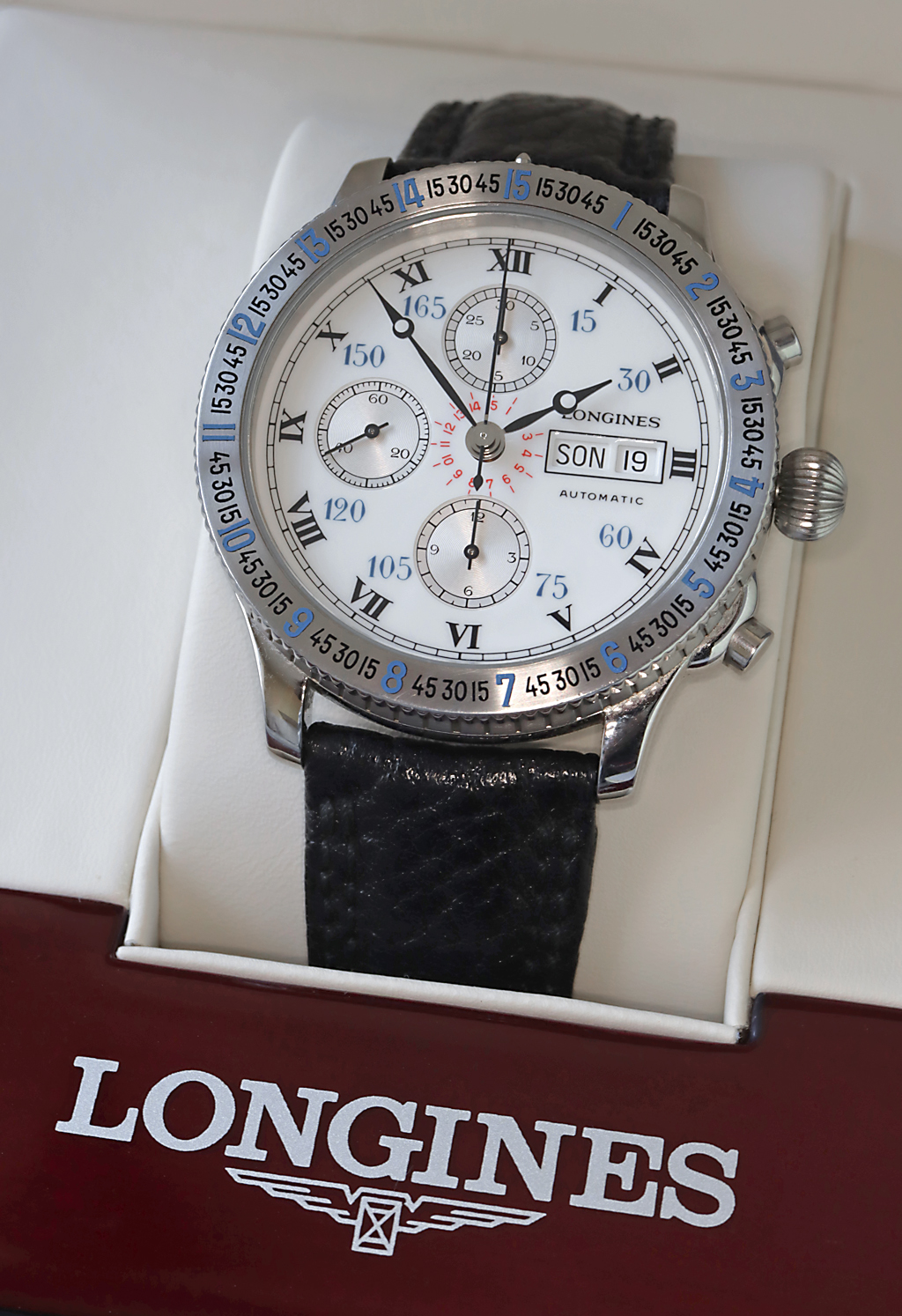
The engineering of the Weems Second-Setting watch is centered around its unique synchronization mechanism. The watch is powered by a high-grade manual wind Longines caliber, typically the 10L or 12.68N, known for their robustness and reliability in field conditions. The most striking technical feature is the external rotating bezel, graduated for 60 seconds, which is locked or adjusted via a secondary crown located at the 4 o'clock position. This allowed the wearer to align the zero mark of the bezel with the seconds hand at the moment of a radio time signal, effectively 'zeroing' the watch for navigation purposes. The case is constructed from staybrite stainless steel, featuring a modest diameter by modern standards—approximately 28mm to 33mm depending on the specific reference—but possessing significant wrist presence due to the substantial bezel. The dial features a matte finish with a clear railway minute track and Arabic numerals, optimized for legibility. The crystal is a high-domed acrylic, designed to withstand pressure changes. The blued steel leaf-style hands provide a sharp contrast against the dial, which in this example shows a beautiful 'tropical' patina that collectors highly prize. The inclusion of the U.S. Patent number 2008734 on the dial underscores the innovative nature of the second-setting system at the time of its release.
Historical Context
Introduced in the late 1920s and refined throughout the 1930s and 40s, the Weems system was a precursor to the famous Lindbergh Hour Angle watch. Longines, acting as the official timekeeper for the International Federation of Aeronautics, was the natural partner for Captain Weems' invention. This specific model, bearing the U.S. Naval Academy crest, was often produced for the USNA midshipmen or as commemorative pieces for officers. During World War II, these watches were essential equipment for navigators in both the maritime and aviation sectors, where timing errors of just a few seconds could result in navigation deviations of several miles. The 'Small Weems'—as this size is often called—became a staple for military personnel who required a compact yet highly functional instrument. Historically, this model marks the transition from pocket watch navigation to wrist-worn precision instruments. It represents a time when Longines was at the absolute forefront of technical chronometry, providing the tools that powered global exploration and military strategy. The survival of such pieces in original condition is rare, as most were subjected to the rigors of active service and harsh environments.
Market Intelligence
From an investment perspective, the Longines Weems is a blue-chip vintage asset. While the standard 33mm Weems models are well-regarded, those featuring military or institutional insignia, such as the U.S. Naval Academy crest, command a significant premium. The market for vintage Longines has seen a steady upward trajectory as collectors pivot away from over-saturated brands toward makers with genuine historical substance. Demand is driven primarily by military watch enthusiasts and 'purist' collectors who value the patented synchronization technology. Supply is inherently limited; many of these watches were lost at sea or destroyed during service, and finding an example with an original, unrestored dial and the correct dual-crown configuration is increasingly difficult. Secondary market behavior shows that 'honest' examples with visible patina and clear engravings retain value far better than over-polished or service-dial versions. The brand strength of Longines in the heritage segment remains formidable, and as the company continues to release 'Heritage' re-editions, interest in the original source material—like this Weems—tends to spike. Long-term value retention is considered excellent, as this model is viewed as a foundational piece in the history of the 20th-century tool watch.