WatchIQ
Omega
Omega First Omega Wrist-Chronograph Re-Edition (Reference 516.52.48.30.04.001)
Market Estimate
~$135,000
Specifications
Market Range
Omega
Omega First Omega Wrist-Chronograph Re-Edition (Reference 516.52.48.30.04.001)
Market Estimate ~ $135,000
Market Range
Specifications
Executive Overview
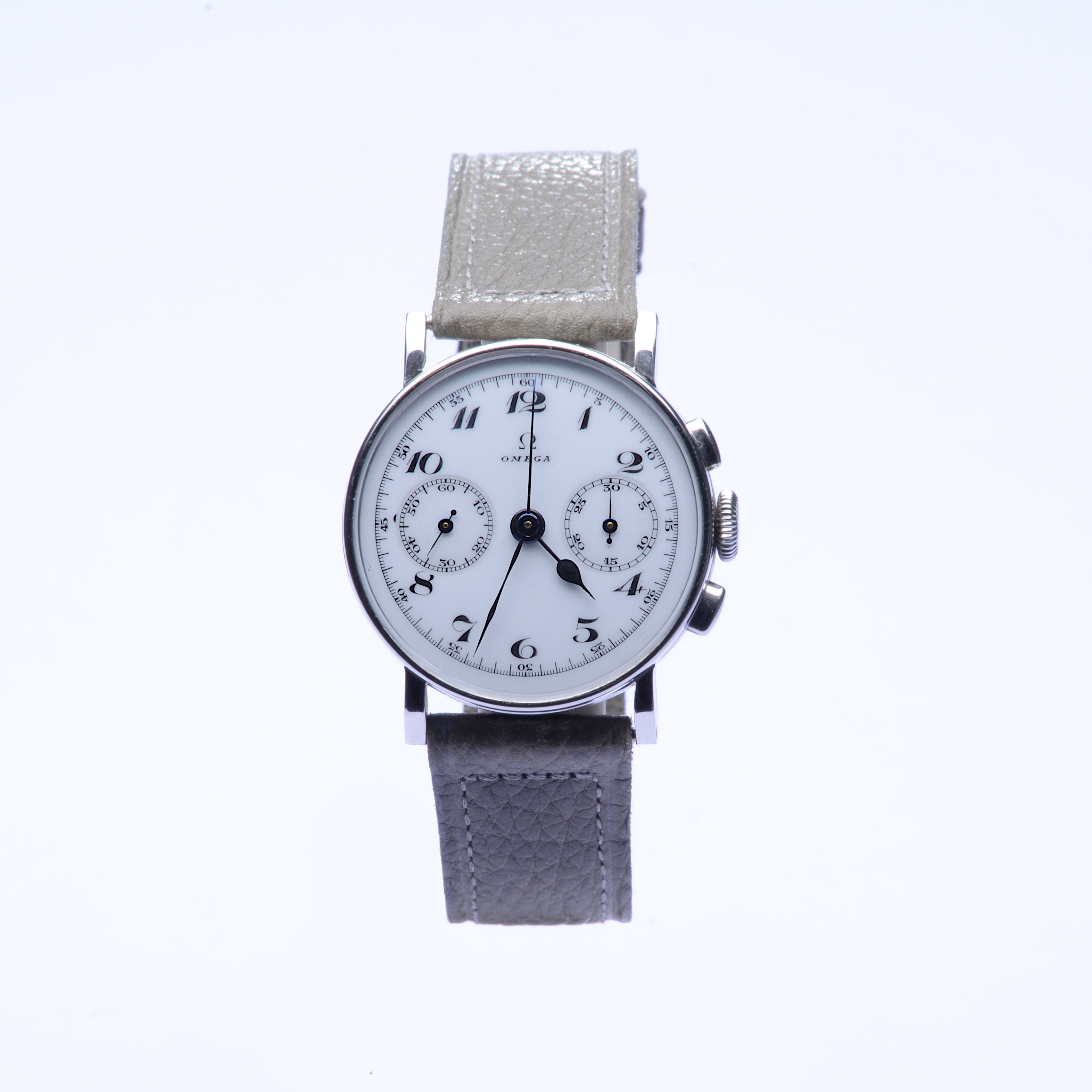
The Omega First Omega Wrist-Chronograph Re-Edition stands as one of the most significant horological achievements in Omega’s modern history. Released as a strictly limited edition of just 18 pieces, this timepiece is not merely a tribute but a literal resurrection of the brand's pioneering spirit. It serves as a faithful recreation of the 1913 18"' CHRO caliber, which was among the world's first wrist-worn chronographs. This specific model bridges the gap between the pocket watch era and the modern wristwatch age, utilizing refurbished original movements from the early 20th century. For the serious collector, this watch represents the pinnacle of Omega’s heritage, combining authentic antique mechanics with modern white gold luxury. It is a 'museum piece' for the wrist, designed for those who value the deep mechanical lineage of the brand over contemporary mass-production. The white enamel dial and blue-steel hands evoke a lost era of elegance, while the oversized 47.5mm case provides a commanding modern presence. Its existence is a celebration of the 'monopusher' complication, a simplified yet mechanically sophisticated method of controlling a chronograph via a single button integrated into the crown or positioned on the case flank. Because of its extreme scarcity and the labor-intensive restoration of its vintage heart, it remains one of the most sought-after modern Omega references in the high-end secondary market.
Technical Architecture
The engineering of this timepiece is centered around the extraordinary Calibre 3018. Unlike modern movements, this is a refurbished original 18-line CHRO movement dating back to 1913. Omega’s Atelier Tourbillon specialists meticulously restored these century-old components to meet modern precision standards while maintaining their historical integrity. The movement is a manual-wind monopusher chronograph, featuring a column-wheel mechanism that provides a tactile and crisp engagement for the timing functions. The case is crafted from 18K white gold, measuring a substantial 47.5mm to accommodate the large pocket-watch-derived movement. The dial is a work of art in itself, featuring 'Grand Feu' white enamel that will never fade or oxidize, paired with classic Breguet-style Arabic numerals and a distinctive 'railway' minute track. The hands are crafted from thermally blued steel, offering a sharp contrast against the stark white surface. A sapphire crystal protects the dial, while the case back is often hinged or features a transparent window to display the intricate, gold-plated movement bridges and balance wheel. The watch is finished with a period-correct leather strap with white gold hardware, emphasizing its transition from a military-style conversion to a luxury heirloom.
Historical Context
In 1913, Omega made history by producing some of the earliest wrist-worn chronographs, many of which were used by the Royal Flying Corps during World War I. These watches were transitional pieces, utilizing modified pocket watch movements housed in cases with wire lugs for trench use. Fast forward to 2018, Omega decided to celebrate this milestone by locating 18 original 18"' CHRO movements within their vaults. These were not new movements made to look old; they were authentic artifacts of the Edwardian era. This Re-Edition was the result of a multi-year project to showcase Omega's restoration capabilities. It replaced nothing in the current lineup but rather elevated the brand's status into the realm of 'haute horlogerie' restoration, similar to Vacheron Constantin’s 'Les Collectionneurs'. It fits into the broader history of watchmaking as a rare instance where a major manufacturer successfully commercialized a 'new' watch powered by a movement over 100 years old. This release pre-dated the recent industry trend of 'heritage' re-issues, setting a high bar for authenticity that few other brands can match.
Market Intelligence
From an investment perspective, the Omega First Omega Wrist-Chronograph is a blue-chip asset with a unique market profile. With only 18 pieces in existence, supply is virtually non-existent on the open market. Most examples are held in private long-term collections or institutional archives. When they do appear at major auction houses like Phillips or Christie's, they command prices significantly above their original retail of 120,000 CHF. Demand is driven by 'completist' Omega collectors and those who specialize in early 20th-century chronographs. The secondary market behavior for this model is characterized by high price stability and low frequency of sale. Unlike modern Speedmasters, which can fluctuate with social media trends, this model’s value is rooted in its mechanical rarity and historical provenance. The brand strength of Omega, combined with the extreme scarcity of the Calibre 3018, ensures that this model retains its value exceptionally well. It is considered a 'grail' piece, and its long-term appreciation is tied to the increasing global appreciation for 'New Old Stock' (NOS) restoration projects by major houses.
.jpg.jpg)