WatchIQ
Omega
Omega Vintage Jumbo Small Seconds (Ref. 2505)
Market Estimate
~$3,200
Specifications
Market Range
Omega
Omega Vintage Jumbo Small Seconds (Ref. 2505)
Market Estimate ~ $3,200
Market Range
Specifications
Executive Overview
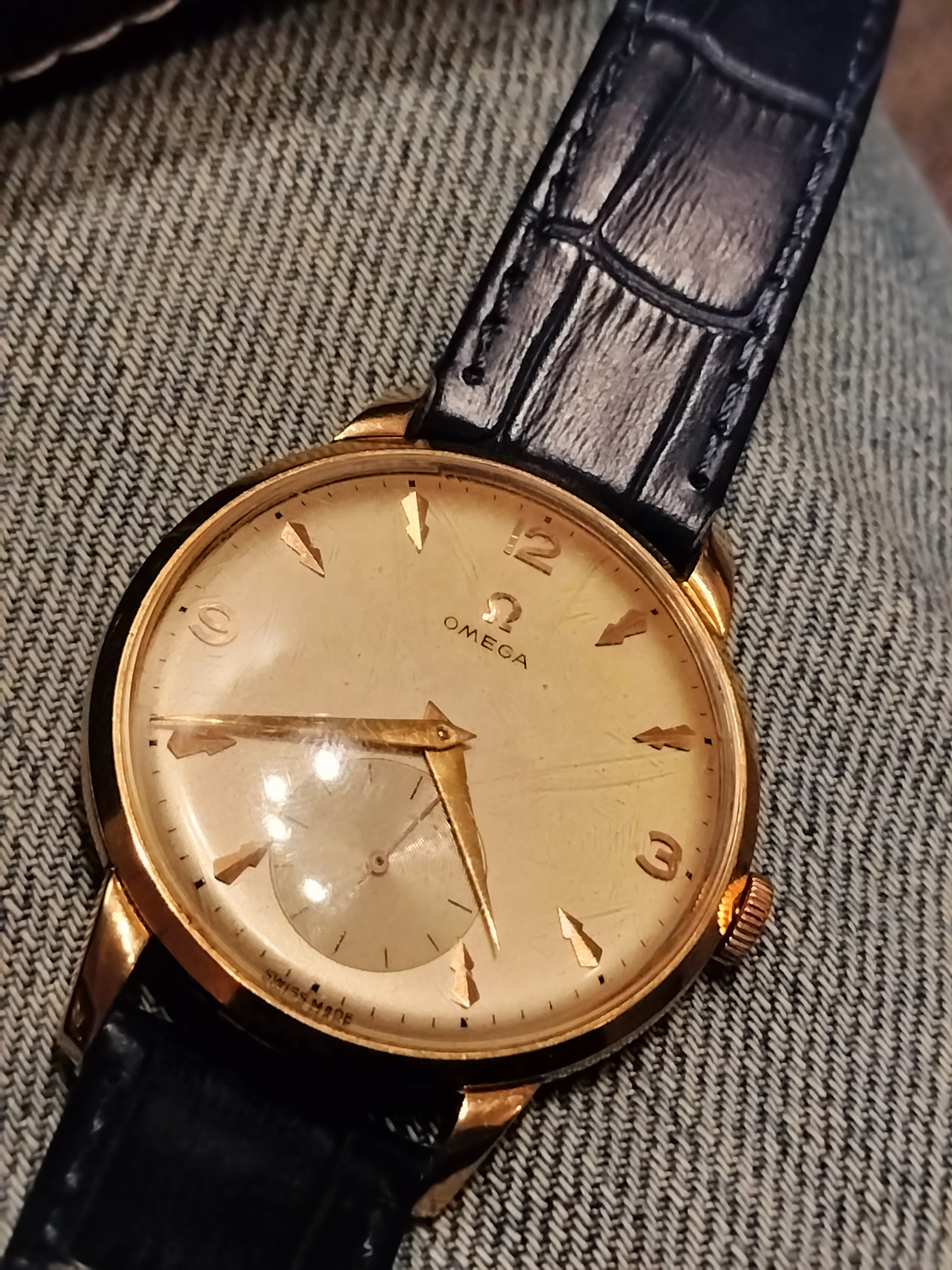
The Omega Vintage Jumbo Small Seconds, specifically identified by its oversized case and distinctive 'Explorer-style' 3-6-9-12 dial configuration, represents a pinnacle of mid-century horological elegance. During an era where the standard gentleman's watch measured a conservative 33mm to 34mm, this 'Jumbo' variant commanded presence with a case diameter exceeding 38mm. This specific model is a masterclass in post-war design, featuring a warm rose gold exterior paired with an aged champagne dial that has developed a unique patina over seven decades. Collectors prize this reference not only for its impressive physical dimensions—which align perfectly with modern stylistic preferences—but also for its purity of form. The absence of a date window ensures perfect symmetry, while the recessed sub-seconds register at the six o'clock position adds a layer of depth and mechanical interest. It exists as a bridge between the utilitarian military pieces of the 1940s and the high-luxury dress watches of the late 1950s. For the discerning collector, this Omega serves as a sophisticated alternative to more common vintage references, offering a blend of rarity, size, and the legendary reliability of Omega's manual-wind movements. It is an artifact of a time when Omega was competing at the very highest levels of chronometric precision and aesthetic refinement.
Technical Architecture
The heart of this timepiece is the legendary Omega Calibre 265 or 266, part of the 30mm movement family that solidified Omega's reputation for robustness and accuracy in the mid-20th century. These movements are celebrated by watchmakers for their logical layout, ease of service, and oversized balance wheel which contributes to superior timekeeping stability. The case construction is notably sophisticated for the period, featuring elongated, down-turned lugs that ensure the large 38.5mm case sits comfortably against the wrist. The crystal is a domed Hesalite acrylic, which provides a warm magnification of the dial and a soft glow that sapphire cannot replicate. The dial architecture is particularly noteworthy; it utilizes applied 'dagger' or 'arrowhead' indices alongside Arabic numerals at the cardinal points, all rendered in matching gold tones. The 'Small Seconds' complication is executed via a sunken sub-dial with a concentric circular graining (azurage) finish, providing a subtle contrast to the matte texture of the main dial. The crown is a period-correct 'flat' style, allowing for tactile engagement with the manual mainspring. Water resistance is negligible by modern standards, as this was engineered as a high-style dress instrument rather than a tool watch, featuring a snap-back case design typical of the 1950s luxury market.
Historical Context
Introduced in the late 1940s and reaching peak production in the early 1950s, the Reference 2505 and its siblings were a bold departure from the diminutive proportions of the pre-war era. This was a period of great expansion for Omega, as they moved from being a supplier of military movements to a global symbol of the 'jet set' lifestyle. The 30mm caliber inside this watch is historically significant as it won numerous observatory trials at Geneva and Kew-Teddington, proving that mass-produced movements could achieve chronometer-grade results. This specific aesthetic—gold cases with sub-second dials—defined the 'Golden Age' of Swiss watchmaking before the industry-wide shift toward automatic movements and the eventual 'Quartz Crisis.' It reflects a time when a watch was a lifetime purchase, often gifted for significant milestones. This model sits in the lineage that eventually birthed the Constellation and Seamaster lines, yet it retains a cleaner, more minimalist DNA that predates those specific collections. Its survival in such original condition, with the applied Omega logo and distinctive faceted indices intact, provides a window into the manufacturing standards of post-war Bienne, where hand-finishing was still a primary component of the assembly process.
Market Intelligence
From an investment perspective, the 'Jumbo' vintage Omega market has seen a significant uptick in demand over the last five years. While standard 34mm vintage Omegas are plentiful, the 38mm+ variants are increasingly difficult to source, particularly in precious metal or high-quality gold plating. The market treats these as 'wearable investments' because their size fits contemporary fashion trends, unlike many smaller vintage pieces that feel undersized today. Secondary market behavior shows a strong preference for 'honest' watches—those with original dials and unpolished cases—over restored examples. Supply dynamics are tightening as seasoned collectors absorb high-quality specimens into long-term holdings. Brand strength for Omega remains at an all-time high, bolstered by modern marketing, which historically pulls the value of vintage counterparts upward. Long-term value retention for this model is categorized as strong; it occupies a 'sweet spot' in the market—more affordable than a Patek Philippe Calatrava of the same era, yet possessing much of the same horological soul and visual gravitas. The rarity of the arrow-head index dial configuration further insulates this asset against market volatility, as it appeals to the 'variant hunter' segment of the collecting community.
.jpg.jpg)