WatchIQ
Rolex
Rolex Explorer I (Reference 214270 MK2)
Market Estimate
~$8,500
Specifications
Market Range
Rolex
Rolex Explorer I (Reference 214270 MK2)
Market Estimate ~ $8,500
Market Range
Specifications
Executive Overview
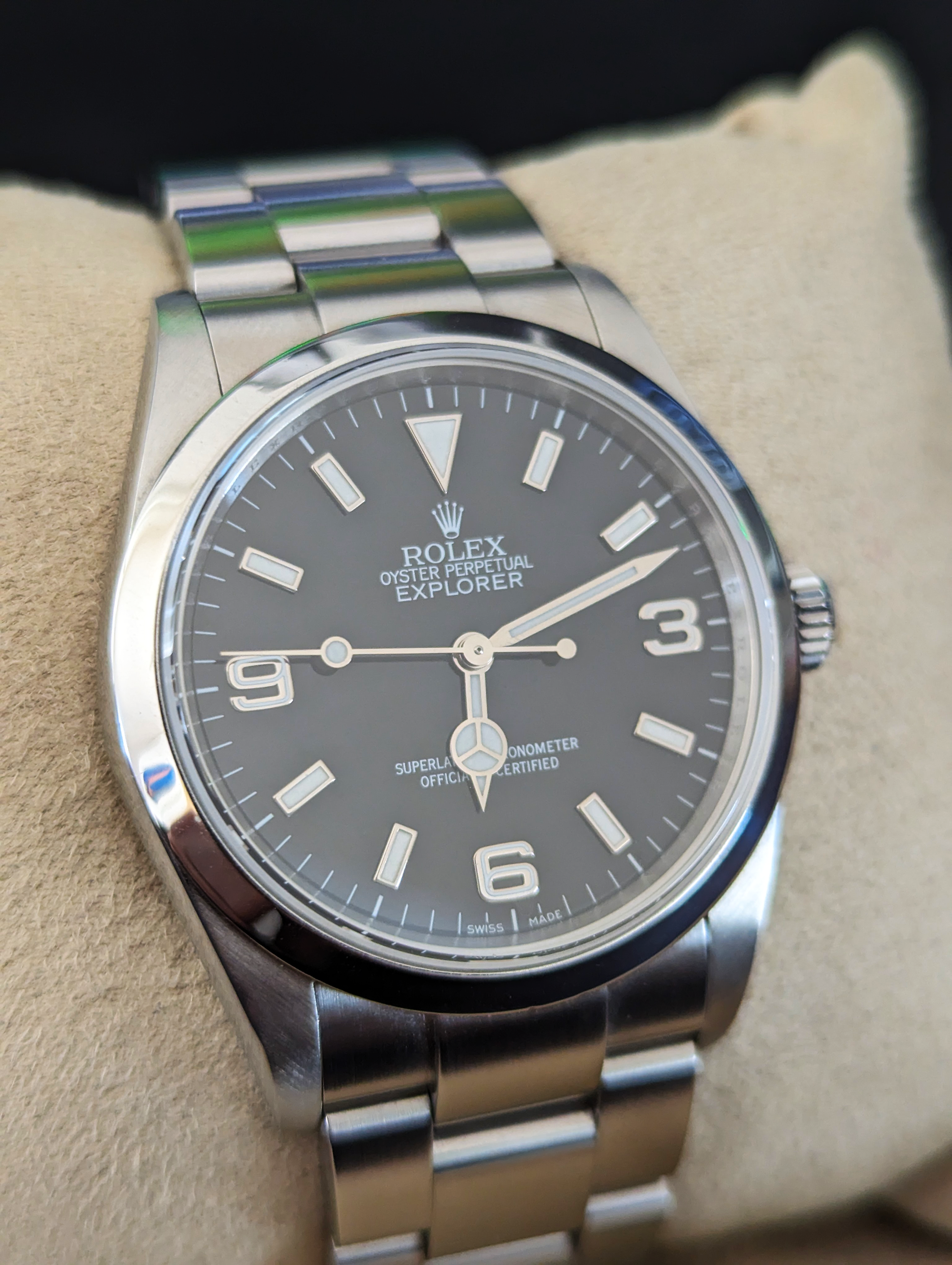
The Rolex Explorer Reference 214270, specifically the 'Mark II' dial configuration, represents the pinnacle of the model's transition into the modern era. Originally introduced in 2010 with a 39mm case, this specific iteration was unveiled at Baselworld 2016 to address collector feedback regarding hand proportions and legibility. It is characterized by the return of luminescent material to the iconic 3-6-9 Arabic numerals and the introduction of lengthened 'Professional' hands that properly reach the minute track. As a purpose-built tool watch, the Explorer exists as the most 'pure' expression of Rolex’s utilitarian philosophy. It eschews the rotating bezels and date magnifiers of its siblings in favor of a clean, symmetrical layout designed for absolute reliability in extreme conditions. For collectors, the 214270 MK2 is a significant reference because it marks the final 39mm Explorer before Rolex returned the model to its traditional 36mm diameter in 2021. This makes it a unique 'Goldilocks' piece—offering modern wrist presence and robust technical specifications while maintaining the understated elegance that has defined the Explorer since its ascent of Mount Everest in 1953. It is a watch that transitions seamlessly from rugged outdoor environments to formal settings, making it a cornerstone for any serious horological investment portfolio.
Technical Architecture
The architecture of the 214270 is defined by the 39mm Oyster case, milled from a solid block of 904L Oystersteel, a superalloy highly resistant to corrosion and capable of a high polish. At its heart beats the Calibre 3132, a self-winding mechanical movement entirely developed and manufactured by Rolex. This movement features a Paramagnetic blue Parachrom hairspring and high-performance Paraflex shock absorbers, providing superior resistance to temperature variations and physical shocks encountered in the field. The dial is protected by a scratch-resistant sapphire crystal and framed by a smooth, fixed steel bezel. The Twinlock screw-down crown ensures a water resistance of 100 meters (330 feet), maintaining the integrity of the Oyster system. The 'Mark II' dial update is technically significant for its use of Chromalight, a luminescent material that emits a long-lasting blue glow, applied not just to the indices and hands, but also to the oversized 3, 6, and 9 numerals. The watch is integrated with a three-link Oyster bracelet featuring the Oysterlock safety clasp and the Easylink 5mm comfort extension link, allowing for micro-adjustments in varying climates. This combination of a larger case size and upgraded movement technology makes it one of the most durable and legible timepieces in the Rolex Professional catalog.
Historical Context
The Rolex Explorer lineage is inextricably linked to the first successful ascent of Mount Everest by Sir Edmund Hillary and Tenzing Norgay in 1953. While the watch that reached the summit was an early Oyster Perpetual, the 'Explorer' brand was launched immediately after to commemorate the achievement. For decades, the Explorer remained a 36mm watch, evolving through legendary references like the 1016, 14270, and 114270. In 2010, responding to the global trend for larger timepieces, Rolex introduced the 39mm 214270. However, the initial 'Mark I' version featured solid white gold numerals without lume and hands that were perceived as too short for the new case diameter. The 2016 update shown here corrected these design elements, creating what many consider the definitive modern Explorer. This model’s production run was relatively short-lived; in 2021, Rolex discontinued the 39mm size entirely to return the Explorer to its 36mm roots. Consequently, the 214270 MK2 occupies a specific and brief chapter in Rolex history as the only time the Explorer was officially scaled up for contemporary tastes, securing its place as a future classic that bridges the gap between vintage aesthetics and modern engineering standards.
Market Intelligence
From an investment perspective, the Rolex Explorer 214270 MK2 is a high-liquidity asset with a very strong value retention profile. Since its discontinuation in 2021, secondary market demand has remained robust as a significant segment of the collecting community prefers the 39mm dimensions over the current 36mm production model. Unlike the more volatile 'hype' watches like the Daytona or GMT-Master II, the Explorer experiences steady, organic growth driven by its reputation as the 'one-watch collection.' Supply is finite given its five-year production window, and as clean, full-set examples become rarer, price appreciation is expected to follow a consistent upward trajectory. The brand strength of Rolex provides a high floor for valuation, while the specific 'discontinued size' status adds a layer of collectible desirability. It is currently viewed as a 'safe haven' asset in the luxury watch market, offering lower volatility than precious metal models while maintaining high desirability among both entry-level enthusiasts and seasoned collectors. Its lack of a date function and ceramic bezel makes it less prone to mechanical failure or aesthetic damage, further supporting its long-term secondary market health.
.jpg.jpg)