WatchIQ
Rolex
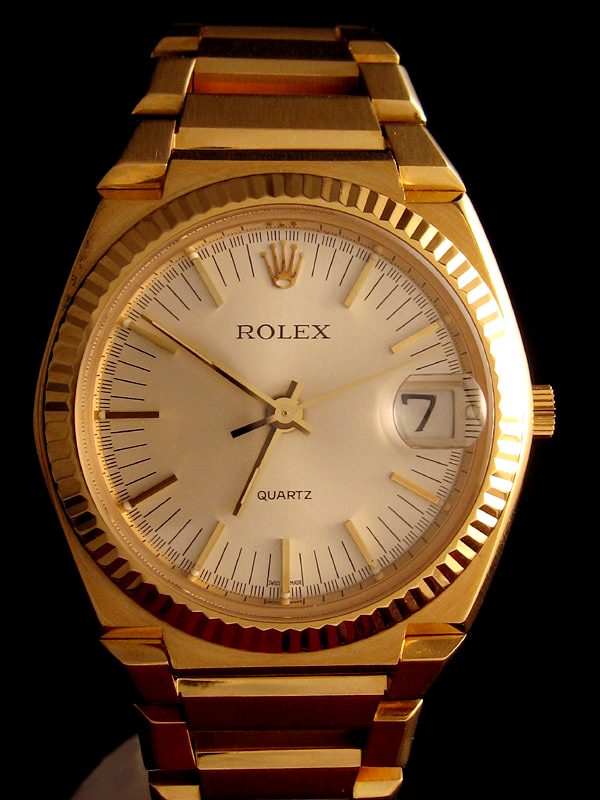
Rolex Oysterquartz Datejust 18k Gold (Ref. 19018)
Market Estimate
~$16,500
Specifications
Market Range
Rolex
Rolex Oysterquartz Datejust 18k Gold (Ref. 19018)
Market Estimate ~ $16,500
Market Range
Specifications
Executive Overview
The Rolex Oysterquartz Datejust, specifically the Reference 19018 in 18k yellow gold, represents one of the most intriguing and technically significant eras in the history of the Genevan manufacture. Produced in limited quantities compared to its mechanical counterparts, the Oysterquartz was Rolex's definitive answer to the 'Quartz Crisis' of the 1970s and 1980s. Unlike the standard Datejust, the Oysterquartz features a distinct, angular case design and an integrated bracelet that echoes the Gérald Genta-inspired aesthetic of the era. This specific model is a masterclass in 1980s luxury, combining the prestige of solid 18k gold with a movement that was, at the time, the most accurate Rolex had ever produced. Collectors are increasingly drawn to this model because it defies the traditional Rolex silhouette, offering a sharp, architectural profile that remains modern today. As an outlier in the Rolex catalog, the Oysterquartz serves as a reminder of a time when the brand was willing to radically innovate its design language to meet a changing technological landscape. Its rarity, coupled with its unique aesthetic, has elevated it from a niche vintage piece to a highly sought-after alternative for those who find the standard Datejust too ubiquitous.
Technical Architecture
The engineering of the Oysterquartz 19018 is centered around the Calibre 5035, an in-house developed quartz movement that remains a marvel of horological engineering. Unlike mass-produced quartz movements, the 5035 is a high-torque, 11-jewel movement that utilizes a traditional pallet fork and escape wheel, resulting in a distinct, audible 'tick' that is a hallmark of the model. The movement is thermocompensated and was COSC-certified, maintaining incredible precision. The exterior architecture is equally impressive, featuring a 36mm tonneau-shaped case in solid 18k yellow gold. The sharp, chamfered edges of the case transition seamlessly into the integrated President-style bracelet, which is unique to the Oysterquartz line. The fluted bezel, a signature Rolex trait, provides a classic contrast to the modern, angular lugs. The watch is equipped with a scratch-resistant sapphire crystal featuring the iconic Cyclops lens over the date aperture at 3 o'clock. Despite its electronic heart, the watch maintains the robust 'Oyster' construction, including a screw-down crown and case back, ensuring water resistance and durability. The craftsmanship required to finish the brushed and polished surfaces of the integrated bracelet is significantly higher than that of standard Oyster bracelets, contributing to its premium feel.
Historical Context
The Rolex Oysterquartz was officially launched in 1977 after five years of intensive research and development. It followed the brand's brief participation in the Centre Électronique Horloger (CEH) consortium, which produced the Beta 21 movement. Dissatisfied with using a movement shared by competitors, Rolex set out to create its own superior quartz calibres. The 19018 was the flagship gold version of this effort. Historically, the Oysterquartz is significant because it represents the only time Rolex moved away from its curved case geometry in favor of a sharp, integrated look. This design shift was heavily influenced by the trend of integrated luxury sports watches popularized by the Royal Oak and Nautilus. Over its roughly 25-year production span, it is estimated that fewer than 25,000 Oysterquartz watches were ever made across all metal variations—a tiny fraction of Rolex's total output. The Ref. 19018 specifically bridged the gap between the utilitarian tool watch and the high-luxury dress watch. It remained in the catalog until the early 2000s, marking the end of Rolex's official foray into high-end quartz before the brand returned to an almost exclusive focus on mechanical movements.
Market Intelligence
From an investment and market perspective, the Rolex Oysterquartz 19018 is currently in a 'discovery phase.' For years, it was overlooked by purists who favored mechanical movements, leading to undervalued pricing. However, the last five years have seen a massive surge in interest for 1970s and 80s integrated-bracelet designs. Because the Oysterquartz was produced in such low volumes, the supply on the secondary market is relatively tight. The solid gold 19018 holds its value exceptionally well due to both its intrinsic gold weight and its rising status as a 'cult classic' among serious horologists. Demand is particularly high for examples with sharp, unpolished case edges, as the architectural geometry is the primary draw for this model. Unlike the steel versions, the 18k gold Oysterquartz occupies a higher tier of collectibility, often appearing in major auction house catalogs. As the market for standard vintage Datejusts becomes saturated, the Oysterquartz offers a compelling 'value-add' for collectors seeking brand prestige with a unique historical narrative. We expect long-term value retention to remain strong, with potential for appreciation as the total number of surviving, high-condition movements dwindles.
.jpg.jpg)