WatchIQ
Tissot
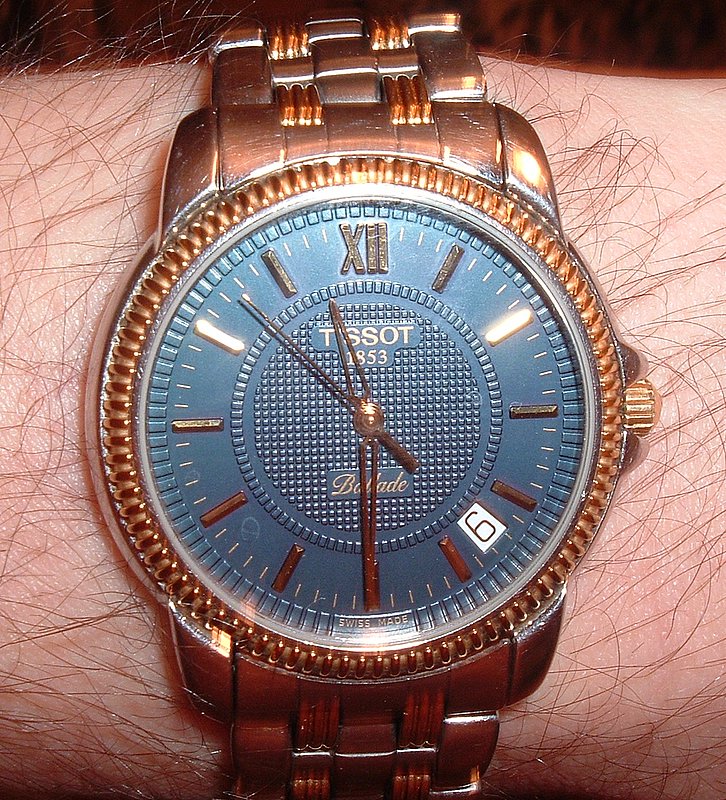
Tissot Ballade III Two-Tone (Reference T031.410.22.033.00 series)
Market Estimate
~$250
Specifications
Market Range
Tissot
Tissot Ballade III Two-Tone (Reference T031.410.22.033.00 series)
Market Estimate ~ $250
Market Range
Specifications
Executive Overview
The Tissot Ballade III represents a pivotal era in the brand's mission to provide accessible Swiss luxury. Positioned as a versatile dress-casual timepiece, this specific model features the signature 'clous de Paris' or hobnail guilloché pattern on the dial and bezel, which has become a hallmark of the Ballade collection. As a member of the T-Classic family, the Ballade III is designed for the consumer who values traditional horological aesthetics—such as the fluted bezel and integrated multi-link bracelet—without the high entry price of mechanical complications. This particular iteration utilizes a two-tone aesthetic, blending the durability of stainless steel with the warmth of gold PVD coating, creating a look reminiscent of high-end Swiss icons from the late 20th century. Collectors and enthusiasts appreciate the Ballade III not for its scarcity, but for its reliability and its role as a 'gateway' Swiss watch. It offers a sophisticated presence on the wrist, characterized by its textured blue dial and Roman numeral accents, making it suitable for both professional environments and formal occasions. While often overshadowed by Tissot's newer Powermatic 80 movements, the quartz-driven Ballade III remains a testament to the brand's consistent build quality and timeless design language that bridges the gap between vintage inspiration and modern manufacturing.
Technical Architecture
The technical foundation of the Tissot Ballade III is centered on a robust 316L stainless steel chassis, treated with a physical vapor deposition (PVD) gold coating on the bezel and central bracelet links. The case typically measures approximately 39mm to 40mm, a contemporary size that retains classic proportions. One of the most distinctive engineering features is the bi-textured bezel, which combines a polished outer ring with a fine hobnail pattern, providing a tactile and visual complexity rarely seen in this price segment. Protecting the dial is a scratch-resistant sapphire crystal, a standard for Tissot that ensures long-term clarity. Inside, the watch is powered by a high-grade Swiss ETA quartz movement (likely the F06.111 or similar caliber), which offers superior accuracy and a low-maintenance ownership experience compared to mechanical counterparts. The dial architecture is multi-layered, featuring a central zone with a stamped grid pattern, an outer minute track, and applied indices. The date window is positioned at 4:30, a functional choice that preserves the symmetry of the primary hour markers. The bracelet is a five-link construction, utilizing a butterfly clasp with push-buttons, ensuring a secure and seamless fit. With a water resistance rating of 30 meters (3 ATM), the architecture is geared toward daily wear and splash protection rather than aquatic activities.
Historical Context
Tissot, founded in 1853 in Le Locle, Switzerland, has long occupied a unique position within the Swatch Group as the 'innovator by tradition.' The Ballade collection specifically emerged as a core pillar of their 'T-Classic' line, aiming to capture the elegance of mid-century watchmaking. This specific generation, the Ballade III, was introduced in the late 2000s and early 2010s as a refinement of the original Ballade series. It served as a bridge between the purely traditional designs of the 1990s and the high-tech silicon-balance spring models that would eventually define the Ballade name in 2017. Historically, the Ballade III was Tissot's answer to the demand for a 'daily driver' that looked significantly more expensive than its retail price suggested. It drew inspiration from the luxury steel-and-gold sports-chic trend that dominated the 1980s and 90s, popularized by brands like Rolex and Cartier, but localized it for a broader audience. While the newer Ballade models have moved toward COSC-certified automatic movements, this quartz version represents the peak of Tissot's high-volume, high-quality production era, where the focus was on aesthetic refinement and Swiss-made reliability for the mass market.
Market Intelligence
From a market intelligence perspective, the Tissot Ballade III is classified as a high-volume, entry-level luxury asset. Its value retention is characteristic of quartz-driven Swiss watches in this segment; it experiences an initial depreciation from MSRP but maintains a stable floor on the secondary market due to the enduring reputation of the Tissot brand. Demand remains consistent among first-time buyers and those seeking a reliable 'office watch' that carries the 'Swiss Made' prestige. Unlike limited edition chronographs or vintage mechanical pieces, the Ballade III does not typically see speculative price appreciation. Instead, its strength lies in its liquidity; because it is a well-recognized model from a trusted brand, it is easily traded or sold on platforms like Chrono24 or eBay. The supply is relatively high, as Tissot produced these in significant quantities to meet global demand. However, finding examples in 'New Old Stock' (NOS) condition is becoming increasingly difficult as the model has been phased out in favor of the Powermatic 80 variants. For a collector, this watch represents a low-risk acquisition that offers high 'perceived value' and serves as a foundational piece in a Swiss-centric collection.