WatchIQ
Tissot
Tissot Seastar 1000 Automatic (Ref. T19.1.583.31)
Market Estimate
~$650
Specifications
Market Range
Tissot
Tissot Seastar 1000 Automatic (Ref. T19.1.583.31)
Market Estimate ~ $650
Market Range
Specifications
Executive Overview
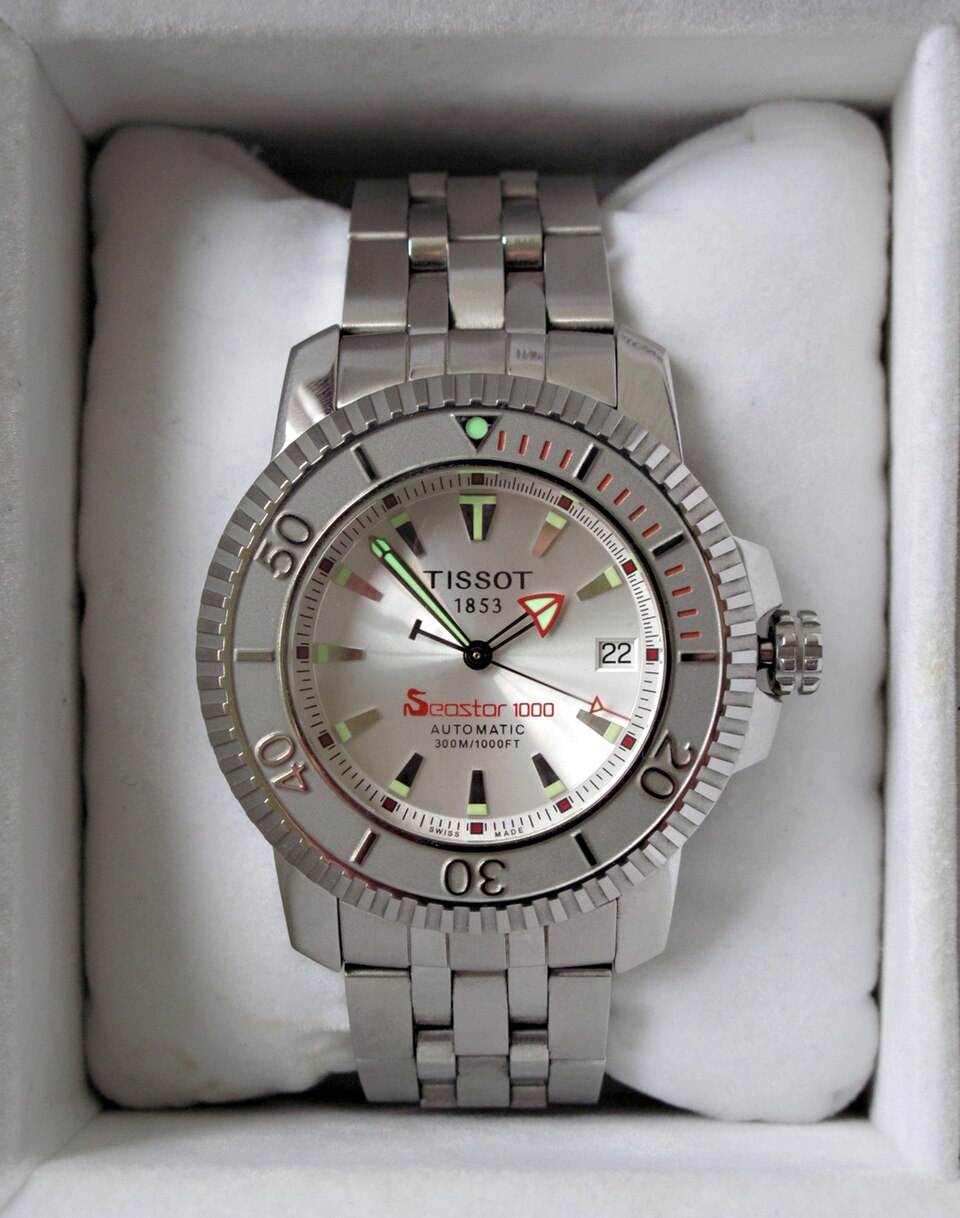
The Tissot Seastar 1000 Automatic, specifically the silver-dial variant from the early 2000s generation, represents a pivotal era for the brand’s dive watch heritage. This model is widely regarded by enthusiasts as a 'modern classic' that bridge the gap between vintage tool watch aesthetics and contemporary manufacturing standards. Featuring a distinctive sunburst silver dial and a bold, coined-edge bezel, it provides a unique visual identity that departs from the ubiquitous 'Submariner' clones often found in this price bracket. Collectors prize this specific generation for its substantial 44mm presence and its unique design language, including the hallmark 'T' seconds hand and the stylized 'S' in the Seastar branding. It serves as a testament to Tissot’s ability to deliver professional-grade specifications—such as 300 meters of water resistance and a helium escape valve functionality—at a price point that remains accessible to the burgeoning horological investor. Its appeal lies in its ruggedness and its status as one of the most recognizable Tissot divers produced in the last two decades, maintaining a loyal following among those who appreciate Swiss engineering without the prohibitive luxury markup.
Technical Architecture
The architecture of this Seastar 1000 is centered around the workhorse ETA 2824-2 automatic movement, a self-winding caliber known for its reliability, 28,800 vibrations per hour, and ease of serviceability. The case is constructed from high-grade 316L stainless steel, measuring approximately 44mm in diameter with a thickness that accommodates its robust 300-meter (1000 feet) water resistance rating. One of its most striking features is the unidirectional rotating bezel, which features a deeply notched 'coin edge' for superior grip and an embossed steel insert that provides a monochromatic, industrial look. The dial is protected by a domed sapphire crystal, which adds a sense of depth and magnification to the silver sunburst finish. The indices and hands are generously coated with Super-LumiNova, ensuring high legibility in low-light environments. Further technical sophistication is found in the exhibition caseback, allowing a view of the movement, and the screw-down crown which is protected by integrated crown guards. The bracelet is a multi-link stainless steel design with a folding safety clasp and a diver's extension, ensuring the watch can be worn over a wetsuit if required for professional use.
Historical Context
The Seastar nameplate has been a staple of the Tissot catalog since the 1950s, originally signifying the brand's water-resistant cases. However, it was the 2003 relaunch of the Seastar 1000 series that redefined the collection as a serious tool watch for the 21st century. This specific model replaced the more conservative designs of the 1990s, introducing a larger, more aggressive footprint that aligned with the 'big watch' trend of the early 2000s. It was a significant release for Tissot as it signaled their commitment to providing high-specification divers under the Swatch Group umbrella, positioned just below Longines and Omega but offering comparable durability. This generation is often credited with revitalizing the Seastar line, leading directly to the ceramic-bezel versions and Powermatic 80 iterations seen today. Historically, it captures a moment in Swiss watchmaking where mechanical movements were regaining massive popularity among the general public, and Tissot leveraged its relationship with ETA to provide a 'Swiss Made' automatic diver that outperformed its cost, solidifying its place in the history of accessible luxury horology.
Market Intelligence
From a market intelligence perspective, the Tissot Seastar 1000 (Generation 1) occupies a stable niche in the secondary market. Unlike mass-produced quartz models, this automatic reference has seen a steady appreciation in interest as collectors seek out 'neo-vintage' pieces from the early 2000s. Supply dynamics are moderately constrained; while many were produced, finding examples with the original silver dial in pristine condition—especially with the original bracelet—is becoming increasingly difficult. The brand strength of Tissot, backed by the Swatch Group, ensures that parts and servicing remain readily available, which is a critical factor for long-term value retention. Demand is driven primarily by entry-level collectors and 'desk-diver' enthusiasts who value the ETA 2824-2 movement over the newer, lower-beat Powermatic 80. While it is not a high-volatility investment asset, it represents a 'blue-chip' entry into the world of Swiss divers. Liquidity is high due to the brand's global recognition, making it an easy watch to trade or sell. It serves as a reliable store of value for those looking for a functional asset that is unlikely to depreciate further from its current market floor.