WatchIQ
Zenith
Zenith Cairelli 'Tipo CP-2' Chronograph
Market Estimate
~$15,000
Specifications
Market Range
Zenith
Zenith Cairelli 'Tipo CP-2' Chronograph
Market Estimate ~ $15,000
Market Range
Specifications
Executive Overview
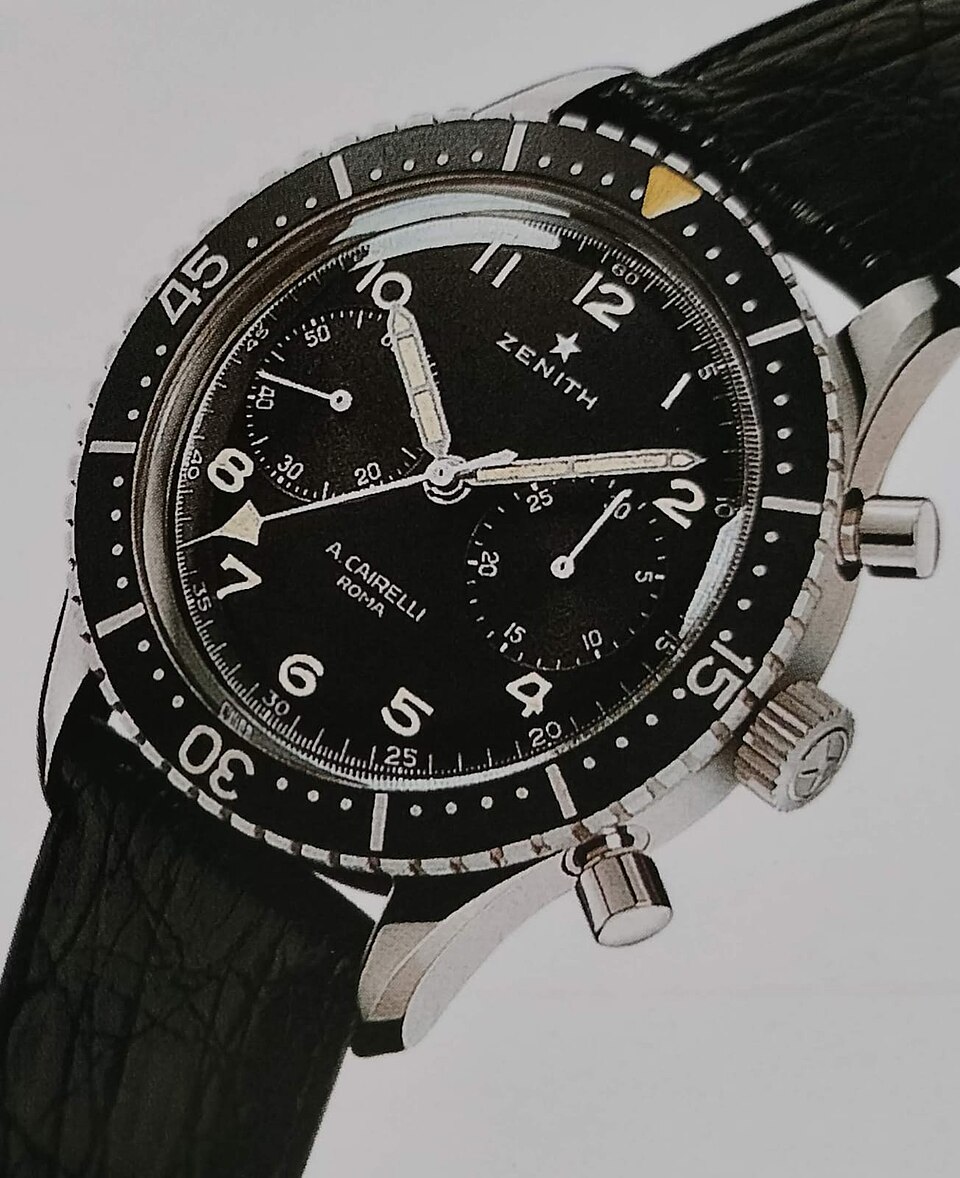
The Zenith Cairelli 'Tipo CP-2' is a cornerstone of military horology, representing a rare intersection of Italian military specifications and Swiss precision engineering. Commissioned by A. Cairelli, a prominent Roman retailer, for the Aeronautica Militare Italiana (Italian Air Force) in the 1960s, this timepiece was never intended for civilian consumption during its original production run. It stands as one of the most iconic pilot's chronographs of the 20th century, characterized by its oversized 43mm case—a diameter that was exceptionally large for its era but necessary for high-altitude legibility. Collectors prize the CP-2 for its 'double-signed' dial, featuring both the Zenith star and the A. Cairelli Roma signature. This model represents the pinnacle of the 'Tipo CP-2' (Cronometro da Polso Tipo 2) designation, a standard that required specific durability and visibility metrics. In the modern market, the Cairelli Zenith is viewed not just as a tool watch, but as a significant historical artifact that captures the mid-century aesthetic of functional aviation design. Its rarity is bolstered by the fact that only approximately 2,500 units were ever produced, many of which saw active service and exhibit unique patinas. For the serious horological investor, the Cairelli offers a combination of scarcity, military provenance, and the mechanical integrity associated with the Zenith brand prior to the El Primero era.
Technical Architecture
The technical foundation of the Zenith Cairelli is centered around the Calibre 146 DP, a manual-wind chronograph movement based on a Martel ebauche. This caliber is celebrated for its reliability and smooth pusher engagement, operating at 18,000 vibrations per hour. The architecture of the watch is defined by its substantial 43mm stainless steel case, which features a stepped lug design that provides a robust wrist presence. The bi-directional rotating bezel is finished in black anodized aluminum, featuring a 60-minute scale used by pilots for navigation and fuel timing. The dial is a masterclass in functional design: a matte black 'ghost' or 'tropical' capable surface with luminous Arabic numerals and oversized 'pencil' hands coated in tritium. The two-register layout provides a 30-minute counter at 3 o'clock and running seconds at 9 o'clock, ensuring a balanced and uncluttered interface. Protection is provided by a domed hesalite (acrylic) crystal, which was standard for military issue to prevent shattering in pressurized cockpits. The case back is typically screw-down and, in authentic military-issued examples, carries the 'A.M.I.' (Aeronautica Militare Italiana) engravings and serial numbers, though some 'civilian' stock remained with the retailer without military markings.
Historical Context
The Zenith Cairelli was born out of the Cold War necessity for specialized aviation equipment. During the 1960s, the Italian Ministry of Defense established the CP-2 specification for its pilots, following the smaller CP-1 standard. Zenith, through its partnership with the Roman distributor Antonio Cairelli, secured the contract to supply these instruments. This era was a transformative period for Zenith, as they were integrating the expertise of Martel Watch Co. to refine their chronograph movements, a path that would eventually lead to the development of the El Primero. The Cairelli Zenith was a peer to other legendary military chronographs like the Heuer Bund and the Breguet Type XX, yet it occupied a unique niche due to its Italian distribution. By the late 1960s, the rise of jet aviation and the eventual shift toward quartz and automatic movements led to the retirement of the CP-2. However, its design language was so influential that Zenith released a 'Heritage' tribute to this model in 2016, further cementing the original's status in the annals of watchmaking history. It remains the definitive example of the 'Cairelli' style, a term now synonymous with high-end vintage military chronographs.
Market Intelligence
The market for the Zenith Cairelli is characterized by high demand and extremely low supply, particularly for examples in original, unpolished condition. As a 'blue-chip' vintage military asset, its value has seen steady appreciation over the last decade. Unlike mass-produced luxury watches, the Cairelli benefits from a finite supply of approximately 2,500 units, many of which were lost or destroyed during service. Market behavior indicates that 'A.M.I.' marked case backs command a significant premium over the non-assigned 'overstock' versions, as military provenance is a primary driver for collectors in this segment. The brand strength of Zenith has surged recently, bolstered by a renewed interest in their vintage catalog, which provides a 'halo effect' for historical models like the CP-2. Secondary market liquidity is high; when a crisp example appears at major auction houses (Phillips, Christie's, or Sotheby's), it frequently exceeds estimates. Investors should monitor the condition of the bezel and the originality of the tritium lume, as these factors significantly impact valuation. Long-term value retention is considered excellent, as the watch is viewed as a 'must-have' for any comprehensive military or chronograph collection.