WatchIQ
Zenith
Zenith Defy Surf SZ 100
Market Estimate
~$1,200
Specifications
Market Range
Zenith
Zenith Defy Surf SZ 100
Market Estimate ~ $1,200
Market Range
Specifications
Executive Overview
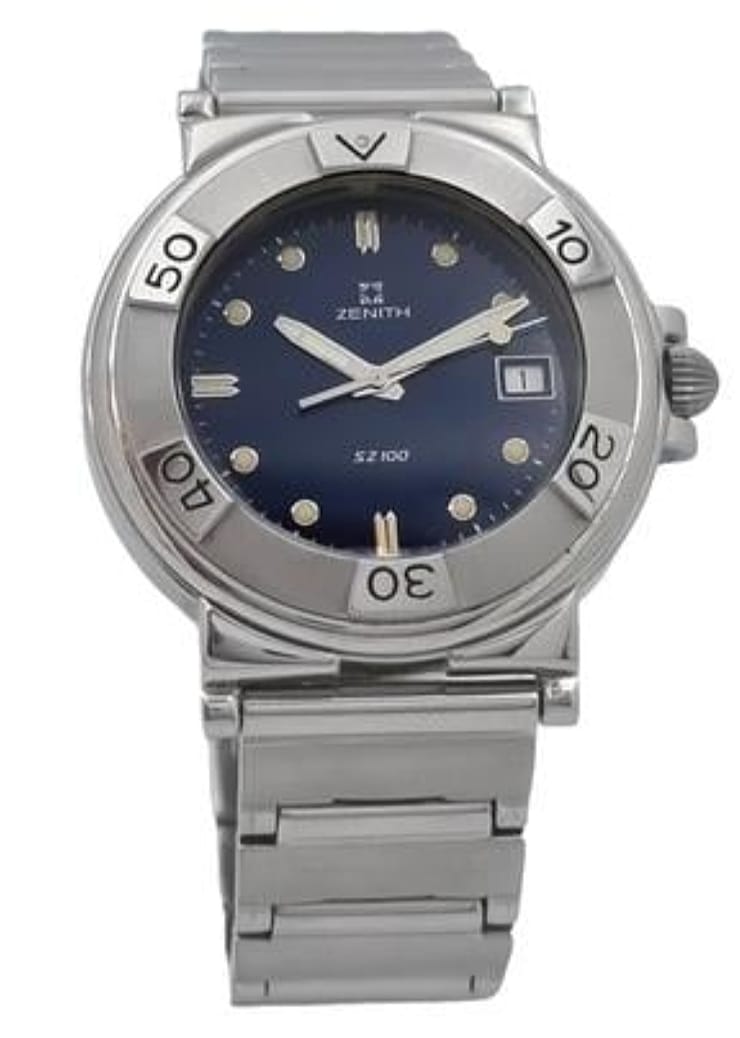
The Zenith Defy Surf SZ 100 represents a fascinating transitional era for the Le Locle-based manufacture, capturing the bold, industrial aesthetic of the late 1980s and early 1990s. As part of the 'Defy' lineage—a collection historically synonymous with ruggedness and 'robustness'—this specific model serves as a testament to Zenith's survival and adaptation during the post-Quartz Crisis landscape. It features a distinct, almost architectural design language characterized by its integrated-style bracelet and a unidirectional rotating bezel with pronounced, raised numerals. The SZ 100 is not merely a timekeeper but a piece of industrial design that prioritized durability and legibility. Collectors are increasingly drawn to these neo-vintage Zenith models because they offer a unique entry point into the brand's history, sitting between the legendary El Primero chronographs and the modern Defy Extreme. Its deep blue dial and utilitarian steel construction make it a versatile daily wearer that carries the prestige of a high-horology house in a more accessible, quartz-driven package. This model is particularly valued for its 'Surf' designation, implying a higher degree of water resistance and sport-readiness compared to the brand's dressier offerings of the period.
Technical Architecture
The technical construction of the Zenith Defy Surf SZ 100 is centered around an incredibly robust stainless steel chassis designed to withstand significant environmental pressure. The case features a brushed finish that minimizes the visibility of scratches, emphasizing its tool-watch DNA. At its heart lies a high-precision Swiss quartz movement, a choice that reflects the era's demand for maintenance-free reliability and superior accuracy. The dial is protected by a flat mineral or sapphire crystal, framed by a heavy-duty unidirectional bezel. This bezel is notable for its 'rider tab' style protrusions at the ten-minute intervals, which allow for easy manipulation even while wearing gloves. The crown is protected by substantial integrated guards, a critical feature for a watch intended for aquatic use. One of its most defining technical features is the integrated stainless steel bracelet, which utilizes a flat-link system that provides both flexibility and high tensile strength. The clasp is typically a fold-over security design, ensuring the watch remains fastened during rigorous activity. The matte blue dial features applied luminous indices and a date aperture at 3 o'clock, optimized for high-contrast visibility in low-light conditions.
Historical Context
The Defy collection was originally launched by Zenith in 1969, the same year as the El Primero, and was marketed as the 'coffre-fort' (safe) of watches due to its patented suspension system and high water resistance. By the time this SZ 100 model was released in the early 1990s, Zenith was refining its identity under the leadership of the North American Watch Company and later LVMH. This model reflects a period where Zenith was balancing its heritage in mechanical excellence with the market's reality, which heavily favored the precision and slim profiles of quartz technology. The 'Surf' moniker was a legacy branding used by Zenith to denote watches with enhanced water seals. This specific generation of the Defy helped bridge the gap between the funky, angular 'Spaceman' designs of the 1970s and the sophisticated, luxury-sport aesthetic of the 21st century. It stands as a relic of a time when Zenith was proving it could produce high-quality, durable sports watches that could compete with the likes of TAG Heuer and Omega in the professional diving and sailing categories.
Market Intelligence
From an investment and market perspective, the Zenith Defy Surf SZ 100 is currently positioned in the 'undervalued neo-vintage' category. While it does not command the astronomical prices of the 1969 El Primero references, it is seeing a steady climb in interest as collectors look beyond the usual suspects for authentic heritage. The secondary market for these watches is characterized by low volatility but increasing scarcity of well-preserved examples. Because these were intended as 'beaters' or tool watches, many have suffered significant cosmetic wear; therefore, specimens with crisp bezel markings and original bracelets command a premium. Demand is driven primarily by Zenith enthusiasts and collectors of 90s sports watches who appreciate the brand's 'insider' status. The supply is relatively limited compared to mass-produced quartz watches of the same era, providing a floor for its value retention. As the modern Defy collection continues to be a flagship for Zenith, these ancestral models serve as important historical touchpoints, likely leading to long-term appreciation as the brand's overall market cap continues to rise under LVMH management.