WatchIQ
Zenith
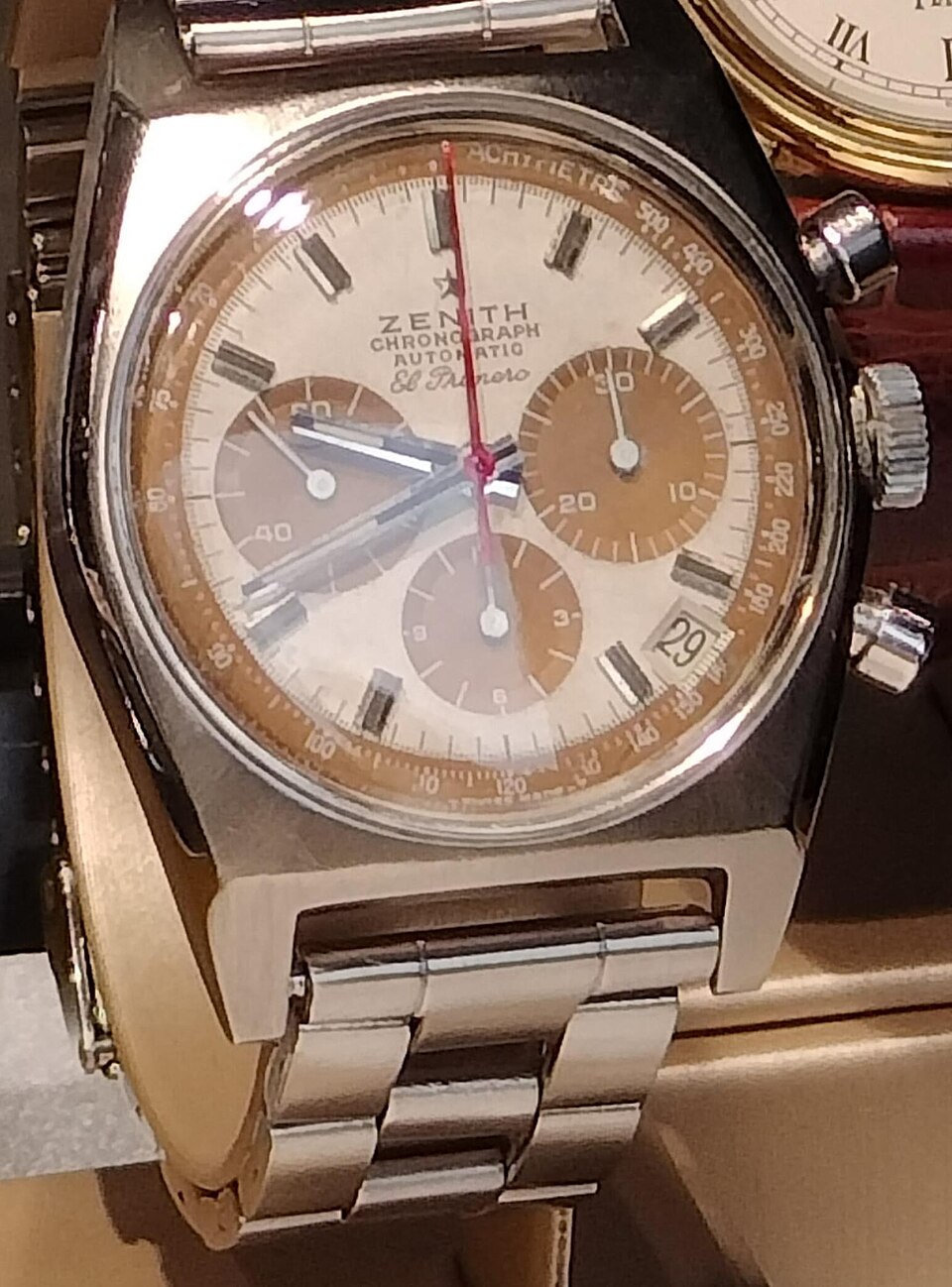
Zenith El Primero A385 'Tropical' Dial
Market Estimate
~$12,500
Specifications
Market Range
Zenith
Zenith El Primero A385 'Tropical' Dial
Market Estimate ~ $12,500
Market Range
Specifications
Executive Overview
The Zenith El Primero A385 is an essential pillar of horological history, representing one-third of the original trio of stainless steel watches launched in 1969 to house the world's first integrated automatic chronograph movement. While its siblings, the A384 and A386, are often cited for their geometric case and tri-color dials respectively, the A385 distinguished itself with a sophisticated khaki-brown gradient dial—a design choice that was remarkably ahead of its time. This specific example showcases a 'tropical' transformation, where the original smoked gradient has aged into a warm, uniform tobacco hue, a phenomenon highly prized by vintage enthusiasts. The A385 is characterized by its sharp, angular tonneau-shaped case, which provides a bold architectural presence on the wrist. Collectors gravitate toward this model not only for its mechanical significance but for its unique aesthetic palette, which offers a more earthy and rugged alternative to the clinical precision of other 1970s chronographs. Owning an A385 is a statement of appreciation for the 'golden era' of chronograph development, capturing the moment when Zenith successfully married high-frequency engineering with avant-garde industrial design. As vintage El Primero references continue to climb in value, the A385 remains a critical acquisition for those seeking to complete the historical trilogy of the 3019 PHC movement.
Technical Architecture
At the heart of the A385 lies the legendary Calibre 3019 PHC, a high-frequency integrated automatic chronograph movement beating at 36,000 vibrations per hour (5Hz). This technical feat allowed for the measurement of elapsed time to the nearest 1/10th of a second, a benchmark that remained the industry standard for decades. Unlike modular chronographs of the era, the El Primero was designed from the ground up as an integrated system, utilizing a column-wheel mechanism to ensure precise and tactile actuation of the chronograph functions. The case is a masterpiece of late-60s industrial design, featuring a 37mm tonneau-shaped stainless steel construction with sharp, faceted lugs and a radial brushed finish. The dial architecture includes three sub-registers: a permanent seconds hand at 9 o'clock, a 30-minute counter at 3 o'clock, and a 12-hour counter at 6 o'clock. A unique feature of this movement is the date window positioned at 4:30, providing utility without disrupting the symmetry of the sub-dials. The watch is typically paired with a 'Ladder' bracelet manufactured by Gay Frères, which features open central links that enhance breathability and comfort while contributing to the watch's distinct vintage silhouette. The crystal is a domed acrylic, which adds warmth and distortion to the dial's edge, enhancing the vintage character of the piece.
Historical Context
The year 1969 was a watershed moment in watchmaking, defined by the race to create the first automatic chronograph. Zenith announced the El Primero (meaning 'The First' in Spanish) in January of that year, beating the Chronomatic group and Seiko to the public reveal. The A385 was part of the inaugural launch collection, sitting alongside the tri-color A386 and the white-dialed A384. This era represented the pinnacle of mechanical innovation before the 'Quartz Crisis' nearly extinguished the Swiss industry. Interestingly, the El Primero movement was almost lost to history when Zenith's owners ordered the destruction of the tooling in the 1970s; it was only saved by the defiance of watchmaker Charles Vermot, who hid the equipment in an attic. This act of preservation allowed the movement to be resurrected in the 1980s, famously powering the Rolex Daytona for over a decade. The A385 specifically reflects the transition in design language from the round cases of the 1950s to the bold, geometric shapes of the 1970s. Its gradient dial was one of the first of its kind in the industry, marking Zenith as a pioneer in aesthetic experimentation. Today, the A385 is celebrated as a survivor and a testament to the enduring relevance of high-beat mechanical engineering.
Market Intelligence
The market for vintage Zenith El Primero references has seen a significant upward trajectory over the last five years, driven by a growing recognition of the movement's importance. The A385 occupies a sweet spot in the market; it is rarer than the A384 but generally more accessible than the blue-chip A386. Secondary market behavior shows a strong premium for 'tropical' dials where the aging is even and aesthetically pleasing, as seen in this specimen. Demand is bolstered by Zenith’s own 'Icons' program and their recent 'Revival' series, which has introduced a new generation of collectors to these vintage silhouettes. Supply is inherently limited, as production runs in the early 1970s were relatively small compared to modern standards. As an asset, the A385 offers strong value retention. While it does not experience the speculative volatility of certain steel sports watches from other brands, it benefits from a dedicated and knowledgeable collector base. The brand's strength is currently at a multi-decade high, with Zenith successfully leveraging its heritage to drive contemporary sales. For the investor-collector, a well-preserved A385 with a period-correct Gay Frères bracelet represents a stable 'Buy and Hold' asset with significant cultural capital in the horological community.